The efficient use of fuel : A text-book on fuels and their efficient utilisation for the use of students and technical men in industry / Prepared under the direction of the Education subcommittee of the Fuel efficiency committee of the Ministry of fuel and power.
- Great Britain. Ministry of Fuel and Power. Fuel Efficiency Committee
- Date:
- 1944
Licence: Public Domain Mark
Credit: The efficient use of fuel : A text-book on fuels and their efficient utilisation for the use of students and technical men in industry / Prepared under the direction of the Education subcommittee of the Fuel efficiency committee of the Ministry of fuel and power. Source: Wellcome Collection.
21/826 (page 7)
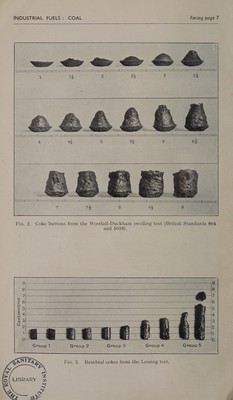
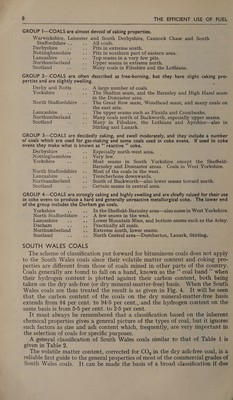
![GROUPING OF COALS The above description of coal types constitutes a rough grouping. Many attempts have been made to devise comprehensive classifications of coals in order that the properties and uses of a coal may be predicted from the analysis of asample. In this country the classification due to Seyler has probably had the biggest vogue, but with the development of fuel technology, all classifica- tions have a decreasing value, since wider ranges of coal can now be utilised than would have been possible a few years ago. For example, the varieties of mechanical stoker now employed in boiler practice enable many coals to be used for steam raising which were not so suitable previously. A coal can be obtained to suit a particular form of stoker, or a stoker installed to burn a particular type of coal. Developments in the gas-making industry, such as the use of blending and the development of vertical retorts, have added to the range of coals suitable for this purpose. Blending is also improving the value of many coals for coke manufacture. There is, therefore, an increasing tendency to rely upon a simplified classification, especially for bituminous coals. A classification of this nature is given in Table 1. TABLE 1], CLASSIFICATION OF BITUMINOUS COALS Group 1 Group 2 Group 3 Group 4 SPESHEAD MOT <a saeai Slightly Medium Strongly een lis g caking caking caking Analysis of Dry Ash-Free ; Coal :— Carbon, per cent. As ae 78-81 81-82-5 82-5-84 84-89 Hydrogen,,, ,, ae 4 5-1-5-6 5-2-5-6 5-2-5°6 4-5-5-5 Volatiles: ; '.,, m4 as 45-4] 42-38 39-35 37-25 Calorific value B.Th.U./Ib, . pe .. | 18860-14400 | 14400-14670 |14670-15030 | 15030-15660 ¢als:/emi.. i «. ‘ -- | 7700-8000 | 8000-8150 | 8150-8350 | 8350-8700 Inherent moisture, per cent.. 16-10 10-7 7-4 4-2 Type of coke, Gray- King Assay AB CDE F to G; G, to. G, W-D Swelling test .. 1 13-24 3-44 5-9 It may prove desirable to divide group 4 into two groups, as follows :— Group 4 Group 5 Carbon, per cent. ay 84-86-5 86-5-—89 Wolawles; 5, 1, a8 37-32 32-25 Calorific value : B.Th.U./Ib. -» 15030-15550 15550-15660 cals./gm. ; -.- 8350-8650 8650-8700 Group 5 would contain coals used for making coke with a high shatter test and generally non-reactive. It will be noted that the calorific value and the percentage of carbon of the dry ash-free coal, as well as the caking and swelling properties, increase in passing from Group 1 to Group 4. On the other hand the percentage of volatile matter and of inherent moisture decrease in the same order. The majority of industrial bituminous coals fall into one or other of the groups. There are exceptions, as, for example, “‘ Hards ’’ which, in general, do not cake; there are also marginal cases. The main purpose of the grouping is to indicate certain properties which have an important bearing on industrial uses. The distribution of these coals in the. various coal-fields of England and Scotland is indicated in the following table, which should be considered as a preliminary guide pending more complete examination.](https://iiif.wellcomecollection.org/image/b32179388_0021.jp2/full/800%2C/0/default.jpg)