Sir James Simpson's introduction of chloroform / By his daughter.
- Eve Blantyre Simpson
- Date:
- [1894]
Licence: Public Domain Mark
Credit: Sir James Simpson's introduction of chloroform / By his daughter. Source: Wellcome Collection.
Provider: This material has been provided by the Harvey Cushing/John Hay Whitney Medical Library at Yale University, through the Medical Heritage Library. The original may be consulted at the Harvey Cushing/John Hay Whitney Medical Library at Yale University.
8/14 (page 416)
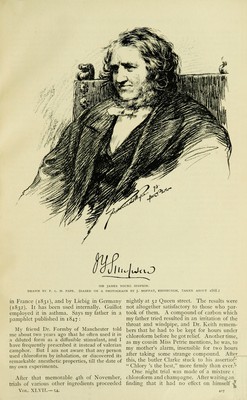
![Your mother was present at the first trial of chloroform, besides your father, Dr. Mathews Duncan, and myself. Several other gases were tried by one or more of us, your father being anx- ious to find something better than ether, which had been used for about a year before, and which came from America — that is, the use of it as an anesthetic. It was not then made pure, as it now is, and the smell was a great drawback. The nearest to chloroform which was tried before this was chloric ether, a new remedy for sickness which had lately come from America. It was not strong enough, but one day your father was talking to an old friend from Bathgate, who was head of a pharmaceutical establishment, Wishart, in Liver- pool. He mentioned that he made chloric ether, not in the usual way, but by first making pure chloroform (a curious liquid long ago discovered by Dumas, but not turned to any use), which he diluted with alcohol to make chloric ether. He promised when he went home from his holiday to send some of it down, as likely stronger than the ether. It was so long in coming that your father got a little from Mr. Hunter of Duncan & Flockhart, and it was this, not more than half an ounce, I think, which we first tried. What makes it very probable that my aunt is correct in saying that my father had a private test of chloroform before a select audience be- fore the trio took it is the statement of Dr. Keith that he (Dr. Keith) took it a few minutes before the others, because my cousin, in her reminiscence of that time, underlines the state- ment, He [my father] tried everything on him- self first ; and Dr. Lyon Playfair, in 1883, speaking on vivisection in the House of Com- mons, corroborates this statement. He says : Sir James Simpson, who introduced chloro- form, that great alleviator of animal suffering, was then alive, and in constant quest of new an- esthetics. He came to my laboratory one day to see if I had any new substances likely to suit his purpose. I showed to him a liquid which had just been discovered by one of my assistants, and Sir James Simpson, who was bold to rashness in experimenting on himself, desired immediately to inhale it in my private room. I refused to give him any liquid unless it was first tried upon rab- bits. Two rabbits accordingly were made to in- hale it, and quickly passed into anesthesia, and soon recovered from it, though by an after action of the poison they both died in a few hours. Now, was this not a justifiable experiment on animals? and was not it worth the sacrifice of two rabbits to save the life of the most distinguished physician of his time, who by the introduction of chloroform has done so much to mitigate animal suffering ? Being bold to rashness, as Dr. Playfair testifies, my father was not likely to have let any ■one get ahead of him, even by a few minutes; but if he had first tried the anesthetic privately on himself, he would have been the more ready to observe the overture to the swooning dream of chloroform enacted by his friend Dr. Keith. Professor Miller thus depicts the awakening of the trio from their early experiment: By-and-by, Dr. Simpson having regained his seat, and Dr. Duncan having come to an arrange- ment with the table and its contents, the sederunt was resumed. Each expressed himself delighted with this new agent; and its inhalation was re- peated many times that night,— one of the ladies gallantly taking her place and turn at the tabic,— until the supply of chloroform was fairly exhausted. In none of the subsequent inhalations, however, was the experiment pushed to unconsciousness. The first event had quite satisfied them of the agent's power. Afterward they held their wits entire, and noted the minor effects on themselves and each other. The festivities did not terminate till a late hour — 3 A. M. The small stock of chloroform was quickly used. Professor Miller says : Mr. Hunter of Duncan, Flockhart & Co. was pressed into the service of restoring the supply, and from that day and hour there was for many months no respite for that gentleman. Working with an ordinary retort, he could not make chloro- form fast enough for the consumption of Dr. Simpson and his friends in their professional practice; and relief only came with the better mode and larger scale of production. Miss Grindlay remembers the trio under the table that November night — how my father and Dr. Mathews Duncan lay sleeping heavily, and how Dr. Keith, who had not taken so kindly to the drug, raised his head in a ghastly semiconscious state above the table, and with the uncanniness of his expression and his star- ing eyes further startled the already frightened audience. Later, when they took it in a smaller quantity, he used to be an obstreperous sub- ject, insisting that the sideboard was a partner to whom he was engaged to dance, and trying to drag this stolid wallflower into the middle of the floor with a successful display of force which astonished the onlookers. Miss Agnes Petrie, my mother's niece, was the first woman who took chloroform, and under its influence was found to imagine herself an angel. My father, wishing to display the power of the new drug, often pressed her into the service, espe- cially to assure patients of the gentler sex that the drug produced not only a harmless, but a beatific state of unconsciousness. My aunt had been so aflxighted at the first trial which she witnessed of chloroform that she absolutely refused to inhale it, and to this day has never been under its influence. This chloroform, which was tried and wel- comed as an anesthetic at Queen street in 1847, was discovered at nearly the same time by Guthrie in America (1831), by Soubeiran](https://iiif.wellcomecollection.org/image/b21003774_0008.jp2/full/800%2C/0/default.jpg)