The constitution of man : considered in relation to external objects / by George Combe.
- George Combe
- Date:
- 1844
Licence: Public Domain Mark
Credit: The constitution of man : considered in relation to external objects / by George Combe. Source: Wellcome Collection.
Provider: This material has been provided by the Harvey Cushing/John Hay Whitney Medical Library at Yale University, through the Medical Heritage Library. The original may be consulted at the Harvey Cushing/John Hay Whitney Medical Library at Yale University.
452/460 page 40
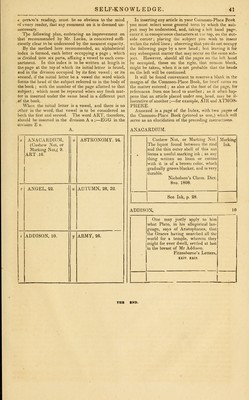
![deavors successful, if they are sincere ; which intro- duces the subject of the following chapter. CHAPTER X. FERVENT AND FREQUENT PRAYER THE MOST EFFEC- TUAL MEANS FOR ATTAINING TRUE SELF-KNOWLEDGE. Lastly. The last means to self-knowledge which I shall mention, is frequent and devout application to the fountain of light, and the father of our spirits, to assist us in this important study, and give us the true know- ledge of ourselves. This I mention last, not as the least, but, on the contrary, as the greast and best means of all, ro attain a right and thorough knowledge of ourselves, and the way to render all the rest effectual; and, therefore, tiiough it be the last means mentioned, it is the first that should be used. Would we know ourselves, we must often converse, not only with ourselves in meditation, but with god in prayer; in the lowest prostration of soul, beseeching the father of our spirits to discover them to us ; ' in whose light we may see light,' where before there was nothing but darkness ; to make known to us the depths and devices of our hearts ; for, without the grace and influence of his divine illuminations and in- structions, our hearts will, after all our care and pains to know them, most certainly deceive us ; and self-love will so prejudice the understanding, as to keep us still in self-ignorance. The first thing we are to do, in order to self-know- ledge, is, to assure ourselves that our hearts ' are de- ceitful above all things;' and the next is, to remember, that, ' the lord searcheth the hearts, and trf*jth the reins ;' Jer. xvii. 10. i. e. that he, the ' Searcher'of all hearts,' Ghron. xxviii. 9., hath a perfect knowledge of them, deceitful as thev are : which consideration, as it suggesteth to us the strongest motive tu induce us to labor after a true knowledge of them ourselves, so it directs us, at the same time, how we may attain this knowledge ; viz. by an humble and importunate appli- cation to him, to whom aioue they are known, to make them known to us. And this, by the free and near ac- cess which his holy spirit hath to our spirits, he can ef- fectually do various wavs ; viz. by fixing our attentions ; by quickening our apprehensions ; removing our pre- judices, which, like a false medium before the eye of the mind, prevents its seeing things in a just and pro- per light; by mortifying our pride ; strengthening the intellective and reflecting faculties ; and enforcing upon the mind a lively sense and knowledge of its greatest happiness and dufcv : and so awakening the soul from ♦sat carnal security and indifference about its best in- terests, into which a too serious attention to the world is apt to betray it. Besides, praver is a very proper expedient for attain- ing self-knowledge, as the actual engagement of the mind, in this devotional exercise, is, in itself, a great help to it; for the mind is in a better frame than when it is intently and devoutly engaged in this duty. It his then the best apprehensions of god, the truest no- tions of itself, and the justest sentiments of earthly things; the clearest conceptions of its own weakness ; and the deepest sense of its own vileness ; and, con- sequently, is in the best disposition than can be, to re- ceive a true and right knowledge of itself. And. oh ! could we but alwavs think of ourselves in such a manner, or could we but always be in a dispo- sition to think of ourselves in such a manner, as we MJinetimes do in the fervor of our humiliations before tne throne of grace, how great a progress should wo soon make in this important science ! Which evidently *bows the necessity of such devoat ~nd bumble en- gagements of the soul, and how happy a means ihrj are to attain a just self-acquaintance. And now, reader, whoever thou art, that hast taken the pains to peruse these sheets, whatever be thy cir- cumstances or condition in the world, whatever thy capacity or understanding, whatever thv occupations and engagements, whatever thy favorite sentiments and principles, or whatever religious sect or party tbou es- pousest, know for certain, that thou hast been deeply in terested in what thou hast been reading, whi ther thou hast attended to it or no : for it is of no less concern to thee than the security of thy peace and usefulness in this world, and thy happiness in another ; and relates to all thy interests, both as a man and a Christian. Perhaps thou hast seen something of thine own image in the glass that has now been held up to thee : and wilt thou go away, and soon ' forget what manner of person thou art?' Perhaps thou hast met with some things thou dost not well understand or approve. But shall that take off thine attention from those things thou dost understand and approve, and art convinced of the necessity of] If thou hast received no improvement, no benefit, from this plain practical treatise thou hast perused, read it over again. The same thought, you know, often impresses one more at one time than another : and we sometimes receive more knowledge and profit by the second perusal of a book than by the first. And I would fain hope that thou wilt find some- thing in this that may set thy thoughts on work, and which, by the blessing of god, may make thee more observant of thy heart and conduct; and, in conse- quence of that, a more solid, serious, wise, and estab- lished Christian. But will you, after all, deal by this book ye have now read, as you have dealt by many sermons you have heard,—pass your judgment upon it according- to your received and establised set of notions ; and condemn or applaud it, only as it is agreeable or disagreeable to them ; and commend or censure it, only as it suits ot does not suit your particular taste ; without attending to the real weight, importance, and necessity of the subject, abstracted from those views? Or, will you barely content with the entertainment and satisfaction which some parts of it may possibly have given you, to assent to the importance of the subject, the justness of the sentiment, or the propriety of some of the ob- servations you have been reading, and so dismiss all, without any farther concern about the matter ] Believe it, O Christian reader! if this be all the advantage you gain by, it were sc-.rce worth while to have con- fined yourself so long to the perusal of it. It has aimed, it has sincerely aimed, to do you a much greater benefit; to bring you to a better acquaintance with one you express a particular regard for, and who is capable of being the best friend, or the worst enemy, you have in the world; and that is—yourself. It was designed to convince you, that, would you live and act consist- ently, either as a man or a Christian, you must know yourself; and to persuade you, under the influencee of the foregoing motives, and by the help of the foremen- tioned directions, to make self-knowledge the great study, and self-government the great business of your life. In which resolution may almighty god confirm you ; and in which great business may his grace assist you against all future discouragements and distractions ! With him I leave the success of the whole, to whom be glory and praise for ever! • APPENDIX, REFERRED TO FROM PAQB 23. The adventage of a common-place book, or register of thing? deemed worthy of retention m the course of](https://iiif.wellcomecollection.org/image/b21029131_0452.jp2/full/800%2C/0/default.jpg)