The constitution of man : considered in relation to external objects / by George Combe.
- George Combe
- Date:
- 1844
Licence: Public Domain Mark
Credit: The constitution of man : considered in relation to external objects / by George Combe. Source: Wellcome Collection.
Provider: This material has been provided by the Harvey Cushing/John Hay Whitney Medical Library at Yale University, through the Medical Heritage Library. The original may be consulted at the Harvey Cushing/John Hay Whitney Medical Library at Yale University.
83/460 page 13
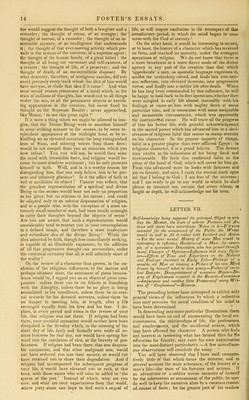
![It is a cause for wonder and sorrow, to see millions of rational creatures growing into their permanent ha- bits, under the conforming efficacy of every thing which they ought to resist, and receiving no part of those ha- bits from impressions of the Supreme Object. They tre content that a narrow scene of a diminutive world, with its atoms and evils, should usurp and deprave and finish their education for immortality, while the Infinite Spirit is here, whose transforming companionship would exalt them into his sons, and, in defiance of a thousand malignant forces attempting to stamp on them an op- posite image, lead them into eternity in his likeness. Oh why is it so possible that this greatest inhabitant of every place where men are living, should be the last whose society they seek, or of whose being constantly near them they feel the importance 1 Why is it possi- ble to be surrounded with the intelligent Reality, which exists wherever we are, with attributes that are infinite, and not feel, respecting all other things which may be attempting to press on our minds and affect their cha- racter, as if they retained with difficulty their shadows of existence, and were continually on the point of vanish- ing into nothing'! Why is this stupendous Intelligence so retired and silent, while present, over all the scenes of the earth, and in all the scenes of the earth, and in all the paths and abodes of men ! Why does he keep his glory invisible behind the shades and visions of the material world ? Why does not this latent glory sometimes beam forth with such a manifestation as could never be for- gotten, nor ever be remembered without an emotion of religious fear ? And why, in contempt of all that he has displayed to excite either fear or love, is it still possi- ble for a rational creature so to live, that it must finally come to an interview with him in a character completed by the full assemblage of those acquisitions, which have separately been disapproved by him through every stage of the accumulation I Why is it possible for feeble crea- j tures to maintain their little dependent beings fortified and invincible in sin, amidst the presence of divine purity ? WTry does not the thought of such a Being strike through tne mind with such intense antipathy to evil, as to blast with death every active principle that is beginning to pervert it, and render gradual additions of depravity, growing into the solidity of habit, as impos- sible as for perishable materials to be raised into struc- tures amidst the fires of the last day 1 How is it possi- ble to forget the solicitude, which should accompany the consciousness that such a Being is continually dart- ing upon us the beams of observant thought, (if we may apply such a term to Omniscience ;) that we are ex- posed to the piercing inspection, compared to which the concentrated attention of all the beings in the universe besides, would be but as the powerless gaze of an in- fant? Why is faith, that faculty of spiritual apprehen- sion, so absent, or so incomparably more slow and reluc- tant to receive a just perception of the grandest of its objects, than the senses are adapted to receive the im- pressions of theirs 1 While there is a Spirit pervading the universe with an infinite energy of being, why have the few particles of dust which encloses our spirits the power to intercept all sensible communication with it, and to place them as in a vacuity, where the sacred Essence had been precluded or extinguished ] The reverential submission, with which you ought to contemplate the mystery of omnipotent benevolence forbearing to exert the agency, which could assume an instantaneous ascendency in every mind over the causes of depravation and ruin, will not avert your compassion ; from the unhappy persons who are practically ' without ! God in the world.' And if, by some vast enlargement ! of thought, you could comprehend the whole measure and depth of disaster contained in this exclusion, (an exclusion under which, to the view of a serious mind, the resources and magnificence of the creation would §ink tnto a mass of dust and ashes, and all the causes of joy ar.d hope into disgust and despair,) you would feel a distressing emotion at each recital of a life in which religion had no share ; and you would be tempted to wish that some spirit from the other world, possessed of eloquence that might threaten to alarm the slumbers of the dead, would throw himself in the way of this one mortal, and this one more, to protest, in sentences of lightning and thunder, against the infatuation that can at once acknowledge there is a God, and be content to forego every connexion with him, but that of danger. You would wish they should rather be assailed by the ' terror of the Lord/ than retain the satisfaction of care- lessness till the day of his mercy be past. But you will not need such enlargement of compre- hension, in order to compassionate the situation of per- sons who, with reason sound to think, and hearts not strangers to feeling, have advanced far into life, per- haps near to its close, without having fdt the influence of religion. If there is such a Being as we mean by the term God, the ordinary intelligence of a serious mind will be quite enough to see that it must be a melancholy thinij to pass through life, and quit it, just as if there were not. And sometimes it will appear as strange as it is melancholy : especially to a person who has been pious from his youth. He would be inclined to sav, to a person who has nearly finished an irreli- gious life, What would have been justly thought of you, if you could have been the greatest part of your time in the society of the wisest and best man on earth, (were it possible to have ascertained that indi- vidual,) and have acquired no degree of conformity ; much more, if you could all the while, have acquired progressively the meanness, prejudices, follies, and vices, of the lowest society, with which you might have been exposed at intervals to mingle ! You might have been asked how this was possible But then through what defect or infatuation of mind have you been able, during so many years spent in the presence of a God, to continue even to this hour as clear of all marks and traces of any divine influences having operated on you, as if the Deity were but a poetical fiction, or an idol in some temple of Asia?—Evidently, as the immediate cause, through want of thought concerning him. And why did you not think of him? Did a most solemn thought of him never once penetrate your soul, while admitting the proposition that there is such a Be If it never did, what is reason, what is mind, what is man ? If it did once, how could its effects stop the How could a deep thought, on so singular and momentous a subject, fail to impose on the mind a per- manent necessity of frequently re-calling it; as some awful or magnificent spectacle will haunt you with a long recurrence of its image, even if the spectacle itself were seen no more 1 Why did you not think of him 1 How could you estimate so meanly your mind with all its capacities, as to feel no regret that an endless series of trifles should seize, and occupy as their right, all your thoughts, and deny them both the liberty and the ambition of going on to the greatest Object \ How, while called to the contemplations which absorb the spirits of Heaven, could you be so patient of the task oi counting the flies of a summer's day 1 Why did you not think of Him 1 You knew your- self to be in the hands of some Being from whose power you could not be withdrawn ; was it not an equal de- fect of curiosity and prudence to indulge a careless con- fidence that sought no acquaintance with his nature and his dispositions, nor ever anxiously inquired what conduct should be observed toward him, and what ex- pectations might be entertained from him 1 You would have been alarmed to have felt yourself in the power of a mysterious stranger, of your own feeble species ; but let the stranger be omnipotent, and you cared no more. Why did you not think of Him? One would deem that the thought of him must, to a serious mind, come second to almost every thought. The thought of vir-](https://iiif.wellcomecollection.org/image/b21029131_0083.jp2/full/800%2C/0/default.jpg)