BSE, the cost of a crisis : thirty-fourth report, together with the proceedings of the Committee relating to the report, the minutes of evidence and appendices / Committee of Public Accounts.
- Public Accounts Committee
- Date:
- 1999
Licence: Open Government Licence
Credit: BSE, the cost of a crisis : thirty-fourth report, together with the proceedings of the Committee relating to the report, the minutes of evidence and appendices / Committee of Public Accounts. Source: Wellcome Collection.
28/68 (page 2)
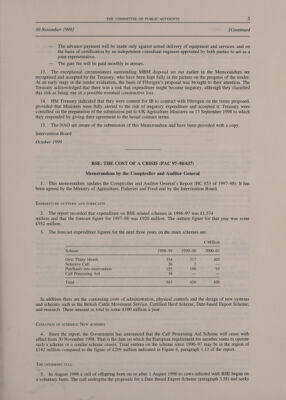
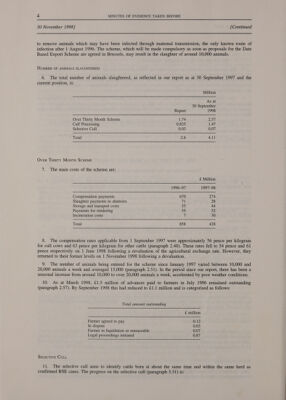
![30 November 1998] [Continued INCINERATION OF MBM 7. Paragraph 4.10 of HC853 records that in the summer of 1997 IB suspended the incineration part of its integrated tender conducted in accordance with the requirements laid down in EC Council Directive 92/50 for the award of public service contracts. The tender had been conducted under the “restricted” procedure specified in the Directive whereby those prospective suppliers who had expressed an interest in response to an advertisement in the EC Official Journal and met basic qualifying criteria were invited to submit a tender. In December 1997 IB terminated the incineration part of the restricted tender because none of the bids met its requirements in terms of reasonable cost and early deliverability. Eight companies with a track record in combustion or in handling MBM were then invited to submit costed proposals for the large scale incineration of MBM under the “negotiated” procedure as provided for in the Directive in such circumstances. 8. Seven companies responded with detailed proposals which were evaluated by an IB Project Board supported by an engineering consultant from the private sector. The key evaluation criteria were energy recovery, appropriate technology, early deliverability, high volumes and reasonable costs. The proposals covered a number of different incineration technologies, but only one was for the conversion of existing plant, the remainder being for new build facilities. The company proposing to convert its existing plant was Fibrogen Ltd, based in North Lincolnshire and, following the evaluation process, they were awarded a contract which was drafted and negotiated with the assistance of experienced commercial lawyers. Negotiations are continuing with three companies about meeting the balance of IB’s requirements for MBM incineration capacity. Of the other three proposals two have been rejected because of failure to meet the evaluation criteria and the third company withdrew its bid. FiIBROGEN Ltp 9. Fibrogen Ltd are already producing electricity by burning poultry litter at their plant near Scunthorpe. The company’s proposals, which was the clear front runner on the basis of objective assessment of all of the proposals received against the key evaluation criteria listed at paragraph 8, involved concerting the plant to burn MBM, an analogous material to poultry litter. The Board’s contract with Fibrogen is for the incineration of at least 255,000 tonnes of MBM over a period of three years, subject to the company obtaining the necessary local authority planning permission and operating consent from the Environment Agency. Based on current forecasts, commissioning (i.e., burning MBM) is expected in Spring 1999, with the start of full operations in late summer 1999. Burning at the full level of the contract will more than match the rate at which MBM is being produced leading to a reduction in the stock by about 15,000 tonnes a year. 10. Contract negotiations with Fibrogen were complicated by the fact that the company is wholly dependant upon a consortium of banks which funded the original construction of the plant. The banks will not be repaid until late 1999 and refused to re-order the schedule in order to allow Fibrogen to raise the capital to convert the plant to burn MBM, or to allow Fibrogen to offer security to a third party until such time as the original debt is fully repaid. Consequently, Fibrogen’s proposal was conditional upon IB advancing a sum to meet the development and construction costs of the project, amounting to some £5.7 million, to be recovered against the fee the company would receive for burning the MBM, which over the three years of the contract would amount to £15.8 million. 11. The contract negotiations resulted in a considerable improvement in the gate fee originally offered by Fibrogen and has provided an option for a fourth year. The gate fee is the amount payable to the company for each tonne of material to be incinerated. The C&AG’s report, on the basis of information then available, concluded that the cost of incineration of MBM in stock at September 1997 could be as high as £70 million (Page 82 of HC853). On the basis of the contract now agreed the cost of incineration of an equivalent tonnage is likely to be around £16 million based on a gate fee of 62 per tonne. However, the position taken by Fribrogen’s banks meant that it was not possible to obtain immediate security for the advance that IB will make for conversion of the plant; this will only happen when the banks have been repaid. The repayment of the bank loan by the company is unlikely to happen until the plant is operating successfully and the gate fee is being paid, which is expected to take 6 to 12 months from the start of commercial burning, with the taxpayer likely to gain security on the advance during the first half of the year 2000. 12. IB recognise that the security arrangements for the advance are unusual and do not match exactly the undertakings given by the Treasury in the Government’s reply to the Committee’s 13th report 1990-91 (A new Ship for St Helena). The inherent risk had to be viewed against the need urgently to. secure a disposal route which offered the best chance of meeting planning and environmental requirements in the least timescale and at a realistic and competitive cost. However, the contract incorporates the following safeguards: — Security in the form of a debenture has been given. The debenture is held in escrow and will come into force as soon as the banks have been repaid. — _ Fibrogen are contractually bound to provide security within 6 months of the start of delivery of the full service and have an incentive to do so since failure will result in a reduction of the gate fee.](https://iiif.wellcomecollection.org/image/b32227048_0028.jp2/full/800%2C/0/default.jpg)