BSE, the cost of a crisis : thirty-fourth report, together with the proceedings of the Committee relating to the report, the minutes of evidence and appendices / Committee of Public Accounts.
- Public Accounts Committee
- Date:
- 1999
Licence: Open Government Licence
Credit: BSE, the cost of a crisis : thirty-fourth report, together with the proceedings of the Committee relating to the report, the minutes of evidence and appendices / Committee of Public Accounts. Source: Wellcome Collection.
33/68 (page 7)
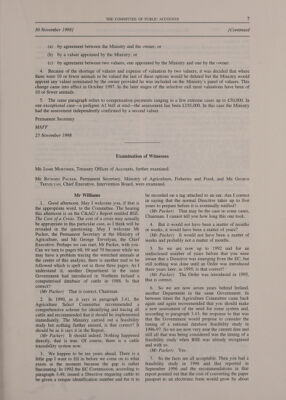
![30 November 1998] [Continued (a) by agreement between the Ministry and the owner; or (b) by a valuer appointed by the Ministry; or (c) by agreement between two valuers, one appointed by the Ministry and one by the owner. 4. Because of the shortage of valuers and expense of valuation by two valuers, it was decided that where there were 10 or fewer animals to be valued the last of these options would be deleted but the Ministry would appoint any valuer nominated by the owner provided he was included on the Ministry’s panel of valuers. This change came into effect in October 1997. In the later stages of the selective cull most valuations have been of 10 or fewer animals. 5. The same paragraph refers to compensation payments ranging in a few extreme cases up to £50,000. In one exceptional case—a pedigree Al bull at stud—the assessment has been £195,000. In this case the Ministry Permanent Secretary MAFF 25 November 1998 Mr Williams 1. Good afternoon. May I welcome you, if that is the appropriate word, to the Committee. The hearing this afternoon is on the C&AG’s Report entitled BSE: The Cost of a Crisis. The cost of a crisis may actually be appropriate in this particular case, as I think will be revealed in the questioning. May I welcome Mr Packer, the Permanent Secretary at the Ministry of Agriculture, and Mr George Trevelyan, the Chief Executive. Perhaps we can start, Mr Packer, with you. Can we turn to pages 68, 69 and 70 because while we may have a problem tracing the wretched animals at the centre of this analysis, there is another trail to be followed which is spelt out in those three pages. As I understand it, another Department in the same Government had introduced in Northern Ireland a computerised database of cattle in 1988. Is that correct? (Mr Packer) That is correct, Chairman. 2. In 1990, as it says in paragraph 3.41, the Agriculture Select Committee recommended a comprehensive scheme for identifying and tracing all cattle and recommended that it should be implemented immediately. The Ministry carried out a feasibility study but nothing further ensued, is that correct? It should be as it says it in the Report. (Mr Packer) It should indeed. Nothing happened directly, that is true. Of course, there is a cattle traceability system now. 3. We happen to be ten years ahead. There is a little gap I want to fill in before we come on to what exists at the moment because the gap is rather fascinating. In 1992 the EC Commission, according to paragraph 3.49, issued a Directive requiring cattle to be given a unique identification number and for it to be recorded on a tag attached to an ear. Am I correct in saying that the normal Directive takes up to five years to prepare before it is eventually ratified? (Mr Packer) That may be the case in some cases, Chairman. I cannot tell you how long this one took. 4. But it would not have been a matter of months or weeks, it would have been a matter of years? (Mr Packer) It would not have been a matter of weeks and probably not a matter of months. 5. So we are now up to 1992 and for an undisclosed number of years before that you were aware that a Directive was emerging from the EC, but still nothing was done until an Order was introduced three years later, in 1995, is that correct? (Mr Packer) The Order was introduced in 1995, that is correct. 6. So we are now seven years behind Ireland, another Department in the same Government. In between times the Agriculture Committee came back again and again recommended that you should make a new assessment of the need for some system and, according to paragraph 3.43, the response to that was that the Government would propose to consider the timing of a national database feasibility study in 1996-97. So we are now very near the current date and still all that was being considered was the timing of a feasibility study when BSE was already recognised and with us. (Mr Packer) Yes. 7. So the facts are all acceptable. Then you had a feasibility study in 1996 and that reported in September 1996 and the recommendations in that report pointed out that the cost of converting the paper passport to an electronic form would grow by about](https://iiif.wellcomecollection.org/image/b32227048_0033.jp2/full/800%2C/0/default.jpg)