BSE, the cost of a crisis : thirty-fourth report, together with the proceedings of the Committee relating to the report, the minutes of evidence and appendices / Committee of Public Accounts.
- Public Accounts Committee
- Date:
- 1999
Licence: Open Government Licence
Credit: BSE, the cost of a crisis : thirty-fourth report, together with the proceedings of the Committee relating to the report, the minutes of evidence and appendices / Committee of Public Accounts. Source: Wellcome Collection.
34/68 (page 8)
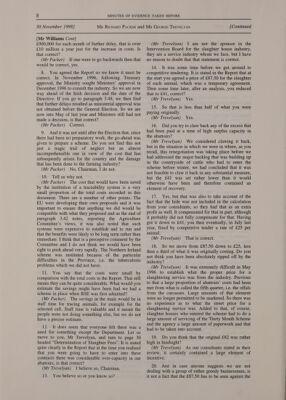
![[Mr Williams Cont] £900,000 for each month of further delay, that is over £10 million a year just for the increase in costs. Is that correct? (Mr Packer) If one were to go backwards then that would be correct, yes. 8. You agreed the Report so we know it must be correct. In November 1996, following Treasury approval, the Ministry sought Ministers’ approval in December 1996 to consult the industry. So we are now way ahead of the Irish decision and the date of the Directive. If you go to paragraph 3.48, we then find that further delays resulted as ministerial approval was not obtained before the General Election. So we are now into May of last year and Ministers still had not made a decision, is that correct? (Mr Packer) Correct. 9. And it was not until after the Election that, since there had been no preparatory work, the go-ahead was given to prepare a scheme. Do you not find this not just a tragic trail of neglect but an almost incomprehensible one in view of the cost that has subsequently arisen for the country and the damage that has been done to the farming industry? (Mr Packer) No, Chairman, I do not. 10. Tell us why not. (Mr Packer) The cost that would have been saved by the institution of a traceability system is a very small proportion of the total costs recorded in this document. There are a number of other points. The EU were developing their own proposals and it was important to ensure that anything we did would be compatible with what they proposed and as the end of paragraph 3.42 notes, reporting the Agriculture Committee’s views, it was also noted that such systems were expensive to establish and to run and that the benefits were likely to be long term rather than immediate. I think that is a perceptive comment by the Committee and I do not think we would have been right to push ahead very rapidly. The Northern Ireland scheme was instituted because of the particular difficulties in the Province, i.e. the tuberculosis problems which we did not have. 11. You say that the costs were small by comparison with the total costs in the Report. That still means they can be quite considerable. What would you estimate the savings might have been had we had a scheme in place when BSE was first admitted? (Mr Packer) The savings in the main would be in staff time for tracing animals, for example for the selected cull. Staff time is valuable and it meant the people were not doing something else, but we do not have a precise estimate. 12. It does seem that everyone felt there was a need for something except the Department. Let us move to you, Mr Trevelyan, and turn to page 30 headed “Determination of Slaughter Fees”. It is stated quite clearly in the Report that at the time you realised that you were going to have to enter into these contracts there was considerable over-capacity in our abattoirs, is that correct? (Mr Trevelyan) I believe so, Chairman. 13. You believe so or you know so? (Mr Trevelyan) 1 am not the sponsor in the Intervention Board for the slaughter house industry, they are a service industry whom we face, but I have no reason to doubt that that statement is correct. 14. It was some time before we got around to competitive tendering. It is stated in the Report that at the start you agreed a price of £87.50 for the slaughter of each animal, which was a temporary agreement. Then some time later, after an analysis, you reduced that to £41, correct? (Mr Trevelyan) Yes. 15. So that is less than half of what you were paying originally. (Mr Trevelyan) 16. Did you try to claw back any of the excess that had been paid at a time of high surplus capacity in the abattoirs? (Mr Trevelyan) We considered clawing it back, but in the situation in which we were in where, as you recall, this renegotiation was taking place before we had addressed the major backlog that was building up in the countryside of cattle who had to enter the scheme before winter, we had concluded that it was not feasible to claw it back in any substantial measure, but the £41 was set rather lower than it would otherwise have been and therefore contained an ~ element of recovery. Yes. 17. Yes, but that was also to take account of the fact that the hide was not included in the calculation from your consultants, so they had that as an extra profit as well. It compensated for that in part, although it probably did not fully compensate for that. Having got it down to £41, you then eventually, in July last year, fixed by competitive tender a rate of £25 per animal. (Mr Trevelyan) That is correct. 18. So we move from £87.50 down to £25, less than a third of what it was originally costing. Do you not think you have been absolutely ripped off by the industry? (Mr Trevelyan) It was extremely difficult in May 1996 to establish what the proper price for a slaughtering service was from the industry. Previous to that a large proportion of abattoirs’ costs had been met from what is called the fifth quarter, i.e. the offals from the carcasses. Large amounts of that element were no longer permitted to be marketed. So there was no experience as to what the street price for a slaughtering service was. Added to that, of course, slaughter houses who entered the scheme had to do a large amount of servicing of the Thirty Month Scheme and the agency a large amount of paperwork and that had to be taken into account. 19. Do you think that the original £82 was rather high in hindsight? (Mr Trevelyan) As our consultants stated in their review, it certainly contained a large element of incentive. 20. Just in case anyone suggests we are not dealing with a group of rather greedy businessmen, is it not a fact that the £87.50 has to be seen against the](https://iiif.wellcomecollection.org/image/b32227048_0034.jp2/full/800%2C/0/default.jpg)