BSE, the cost of a crisis : thirty-fourth report, together with the proceedings of the Committee relating to the report, the minutes of evidence and appendices / Committee of Public Accounts.
- Public Accounts Committee
- Date:
- 1999
Licence: Open Government Licence
Credit: BSE, the cost of a crisis : thirty-fourth report, together with the proceedings of the Committee relating to the report, the minutes of evidence and appendices / Committee of Public Accounts. Source: Wellcome Collection.
39/68 (page 13)
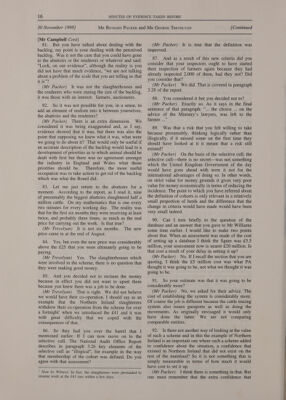
![[Mr Steinberg Cont] 47. That was a very extensive and brave attempt to explain the situation. Could I finally say, that is fair enough and I accept that, but in paragraph 2.66 it says that there were 47 payment calculation errors in the 97 examined claims and 64 claims submitted by abattoirs had errors. With all the problems you had with new staff and the huge increase in staff, it is still not really acceptable for that amount of errors to have taken place as far as the taxpayer was concerned surely? (Mr Trevelyan) Ican certainly agree that I was not happy when I read the results of the NAO’s transaction testing but I think if you look at the next paragraph 2.67 you can see the net result. In fact, in the proper manner of auditors what the NAO has done is grossed up the error, they have taken the errors in favour of the taxpayer and the errors against the taxpayer and reflected a full range of them and have shown that as low as .17 per cent of the payments in the sample testings were in error. The explanation for that is that the claims which were made on the Intervention Board were very extensive indeed. We had slaughter houses which were slaughtering 5,000 animals a week and we were getting claims sent to us with 1,000-1,500 animals on them. If one ear tag number on that claim out of 1,000 beasts was incorrect it was registered as a wrong claim. We could easily in that situation have been in a situation where every single claim was erroneous in one respect or another. So it is not all that astonishing that almost half the claims were erroneous in one respect or another. The important thing is that the gross value of errors in payments themselves was extremely low and I am satisfied that 2.67 is a better representation of the situation than 2.66. Mr Steinberg: If you think £1.7 million is very low I wish I could win that on the pools! Thank you, Chairman. Mr Davies 48. May I start with the last question actually because you have just said the gross value of errors was very low. In fact, figure 16 shows it to be £17 million. Therefore your terms of reference are that £17 million is a very low error and you do not mind the taxpayer losing £17 million of money at a time that this fiasco cost £2.2 billion? Is that your perspective? (Mr Trevelyan) No, I think you have misread the table, Mr Davies. Can I take you to the final column: £17,175.65. 49. Okay, thank you for that. Can I take you back to the more strategic issue and may I ask Mr Packer why we did not have a tracking system in place when Ireland had one in 1988. Given that it is not just Ireland that could get TB and given that foot and mouth disease did hit Britain, there is no real good reason why we did not have a tracking system in place. Had we had one in place we would have known the right price to charge in terms of the cost to abattoirs that was being negotiated on the basis of the guesswork you referred to earlier in terms of the number of beasts available versus the abattoir capacity. (Mr Packer) A cattle tracing system would have been no help in the discussions we were having earlier about the allocation of beasts to abattoirs. 50. Would you not have known the number of cattle if you had a cattle tracing system? You said you did not know what the backlog was and you thought they were trying to rip you off and you did not really know. (Mr Packer) | did not say that, Mr Davies. I said I suspected the backlog was a lot less than it was and that suspicion proved to be well-founded. We know very accurately the number of cattle in the country. A cattle tracing system is not necessary to tell us that. 51. But you would have known had you had a cattle tracing system in place on 20 March 1996 how big this backlog was that no one really knew how big it was. (Mr Packer) No, it would have been of no value. 52. Would you have known how big the backlog was? (Mr Packer) No we would not have known that. The whole point is not a question of how many animals there are in the country, it is a question of intent and whether the farmer regards that animal as having reached the end of its working life and no cattle tracing system can tell you that. 53. You would have had a database of cattle eligible for the Over Thirty Month Scheme. (Mr Packer) We are very well aware anyway of how many cattle are eligible for the Over Thirty Month Scheme. It only comes into play when the farmer decides that the animal has reached the end of its working life. Cattle tracing systems do not help with that. I may say that when we finally decided to go ahead with the cattle tracing system on value-for-money grounds the decision was by no means as clear-cut as you are suggesting. We eventually decided to do so for two reasons: one was it was clear there was going to be a European Union requirement which was in fact agreed shortly thereafter; and the second point was that its precondition in the Florence Agreement and there was no possibility of getting the export ban lifted.’ On strict value-for-money grounds while there are benefits as the Report states in having a cattle tracing system they are long-term. 54. So you are saying that if you had a cattle tracing system you would be in no better position on 20 March 1996 to know how many possible cattle there were to slaughter, whether there was capacity in the market, and you could not have got to the market price of £25 earlier and saved millions of pounds that you in fact loss because you did not have a system? (Mr Packer) Yes I am saying that. 55. Can I ask on that question, you did not know what the market price was until you went for it which was £25 but as the price moved from £87.50 to £41 to £25 had all the animals gone to the abattoirs at £25 how much money would you have saved the taxpayer and how much did you lose through not giving £25 as the market price? ' Note by Witness: Text should read “and the second point was that there was a precondition in the Florence Agreement and there was otherwise no possibility of getting the export ban lifted.](https://iiif.wellcomecollection.org/image/b32227048_0039.jp2/full/800%2C/0/default.jpg)