BSE, the cost of a crisis : thirty-fourth report, together with the proceedings of the Committee relating to the report, the minutes of evidence and appendices / Committee of Public Accounts.
- Public Accounts Committee
- Date:
- 1999
Licence: Open Government Licence
Credit: BSE, the cost of a crisis : thirty-fourth report, together with the proceedings of the Committee relating to the report, the minutes of evidence and appendices / Committee of Public Accounts. Source: Wellcome Collection.
50/68 (page 24)
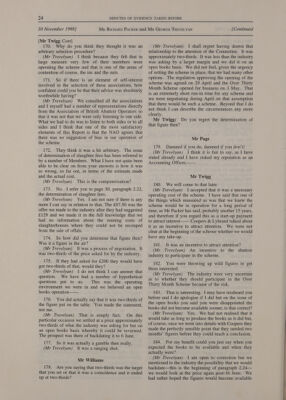
![[Mr Twigg Cont] 170. Why do you think they thought it was an arbitrary selection procedure? (Mr Trevelyan) I think because they felt that in large measure very few of their members were operating the scheme and that is one of the areas of contention of course, the ins and the outs. 171. So if there is an element of self-interest involved in the selection of these associations, how confident could you be that their advice was absolutely worthwhile having? (Mr Trevelyan) We consulted all the associations and I myself had a number of representations directly from the Association of British Abattoir Operators so that it was not that we were only listening to one side. What we had to do was to listen to both sides or to all sides and I think that one of the most satisfactory elements of this Report is that the NAO agrees that there was no suggestion of bias in our operation of the scheme. 172. They think it was a bit arbitrary. The issue of determination of slaughter fees has been referred to by a number of Members. What I have not quite been able to be clear on from your answers is how it was so wrong, so far out, in terms of the estimate made and the actual cost. (Mr Trevelyan) This is the computerisation? 173. No. I refer you to page 30, paragraph 2.22, the determination of slaughter fees. (Mr Trevelyan) Yes. I am not sure if there is any more I can say in relation to that. The £87.50 was the offer we made to the industry after they had suggested £129 and we made it in the full knowledge that we had no information about the running costs of slaughterhouses where they could not be recouped from the sale of offals. 174. So how did you determine that figure then? Was it a figure in the air? (Mr Trevelyan) It was a process of negotiation. It was two-thirds of the price asked for by the industry. 175. If they had asked for £200 they would have got two-thirds of that, would they? (Mr Trevelyan) I do not think I can answer that question. We have had a number of hypothetical questions put to us. This was the operating environment we were in and we believed an open books operation 176. You did actually say that it was two-thirds of the figure put on the table. You made the statement, not me. (Mr Trevelyan) That is simply fact. On this particular occasion we settled at a price approximately two-thirds of what the industry was asking for but on an open books basis whereby it could be reviewed. The prospect was there of backdating it to 6 June. 177. So it was actually a gamble then really. (Mr Trevelyan) It was a ranging shot. Mr Williams 178. Are you saying that two-thirds was the target that you set or that it was a coincidence and it ended up at two-thirds? (Mr Trevelyan) 1 shall regret having drawn that relationship to the attention of the Committee. It was approximately two-thirds. It was less than the industry was asking by a larger margin and we did it on an open books basis. We did not feel, given the urgency of setting the scheme in place, that we had many other options. The regulation approving the opening of the scheme was agreed on 29 April and the Over Thirty Month Scheme opened for business on 3 May. That is an extremely short run-in time for any scheme and we were negotiating during April on that assumption that there would be such a scheme. Beyond that I do not think I can describe the circumstances any more clearly. Mr Twigg: Do you regret the determination of that figure then? Mr Page 179. Damned if you do, damned if you don’t! (Mr Trevelyan) {| think it is fair to say, as I have stated already and I have risked my reputation as an Accounting Officer, Mr Twigg 180. We will come to that later. (Mr Trevelyan) 1 accepted that it was a necessary operating cost of the scheme. I have said that one of the things which reassured us was that we knew the scheme would be in operation for a long period of time, as Mr Packer has said, probably another 15 years, and therefore if you regard this as a start-up payment to attract interest Coopers & Lybrand talked about it as an incentive to attract attention. We were not clear at the beginning of the scheme whether we would have any take-up. 181. It was an incentive to attract attention? (Mr Trevclyan) An incentive to the abattoir industry to participate in the scheme. 182. You were throwing up wild figures to get them interested. (Mr Trevelyan) The industry were very uncertain as to whether they should participate in the Over Thirty Month Scheme because of the risk. 183. That is interesting. I may have misheard you before and I do apologise if I did but on the issue of the open books you said you were disappointed the books did not become available sooner, is that correct? (Mr Trevelyan) Yes. We had not realised that it would take as long to produce the books as it did but, of course, once we went into details with Coopers they made the perfectly sensible point that they needed two months’ figures before they could reach a conclusion. 184. For my benefit could you just say when you expected the books to be available and when they actually were? (Mr Trevelyan) I am open to correction but we mentioned to the industry the possibility that we would backdate—this is the beginning of paragraph 2.24— we would look at the price again post-16 June. We had rather hoped the figures would become available](https://iiif.wellcomecollection.org/image/b32227048_0050.jp2/full/800%2C/0/default.jpg)