BSE, the cost of a crisis : thirty-fourth report, together with the proceedings of the Committee relating to the report, the minutes of evidence and appendices / Committee of Public Accounts.
- Public Accounts Committee
- Date:
- 1999
Licence: Open Government Licence
Credit: BSE, the cost of a crisis : thirty-fourth report, together with the proceedings of the Committee relating to the report, the minutes of evidence and appendices / Committee of Public Accounts. Source: Wellcome Collection.
61/68 (page 35)
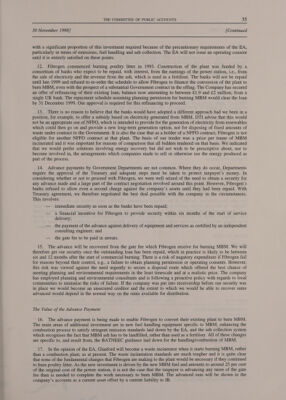
![30 November 1998] [Continued with a significant proportion of this investment required because of the precautionary requirements of the EA, particularly in terms of emissions, fuel handling and ash collection. The EA will not issue an operating consent until it is entirely satisfied on these points. 12. Fibrogen commenced burning poultry litter in 1993. Construction of the plant was funded by a consortium of banks who expect to be repaid, with interest, from the earnings of the power station, i.e., from the sale of electricity and the revenue from the ash, which is used as a fertiliser. The banks will not be repaid until late 1999 and refused to re-order the schedule to allow Fibrogen to finance the conversion of the plant to burn MBM, even with the prospect of a substantial Government contract in the offing. The Company has secured an offer of refinancing of their existing loan, balance now amounting to between £1.9 and £2 million, from a single UK bank. The repayment schedule assuming planning permission for burning MBM would clear the loan by 31 December 1999. Our approval is required for this refinancing to proceed. 13. There is no reason to believe that the banks would have adopted a different approach had we been in a position, for example, to offer a subsidy based on electricity generated from MBM. DTI advise that this would not be an appropriate use of NFFO, which is intended to provide for the generation of electricity from renewables which could then go on and provide a new long-term generation option, not for disposing of fixed amounts of waste under contract to the Government. It is also the case that as a holder of a NFFO contract, Fibrogen is not eligible for another NFFO contract at that plant. The basis of our tender was a price per tonne of MBM incinerated and it was important for reasons of comparison that all bidders tendered on that basis. We indicated that we would prefer solutions involving energy recovery but did not wish to be prescriptive about, nor to become involved in, the arrangements which companies made to sell or otherwise use the energy produced as part of the process. 14. Advance payments by Government Departments are not common. Where they do occur, Departments require the approval of the Treasury and adequate steps must be taken to protect taxpayer’s money. In considering whether or not to proceed with Fibrogen, we were well seized of the need to obtain a security for any advance made and a large part of the contract negotiation revolved around this point. However, Fibrogen’s banks refused to allow even a second charge against the company’s assets until they had been repaid. With Treasury agreement, we therefore negotiated the best deal possible with the company in the circumstances. This involves: — immediate security as soon as the banks have been repaid; — a financial incentive for Fibrogen to provide security within six months of the start of service delivery; — the payment of the advance against delivery of equipment and services as certified by. an independent consulting engineer; and — the gate fee to be paid in arrears. 15. The advance will be recovered from the gate fee which Fibrogen receive for burning MBM. We will therefore get our securtiy once the outstanding loan has been repaid, which in practice is likely to be between six and 12 months after the start of commercial burning. There is a risk of nugatory expenditure if Fibrogen fail for reasons beyond their control, e.g., a failure to obtain planning permission or operating consents. However, this risk was viewed against the need urgently to secure a disposal route which offered the best chance of meeting planning and environmental requirements in the least timescale and at a realistic price. The company has employed planning and environmental consultants and is following a proactive policy with regards to local communities to minimise the risks of failure. If the company was put into receivership before our security was in place we would become an unsecured creditor and the extent to which we would be able to recover sums advanced would depend in the normal way on the sums available for distribution. The Value of the Advance Payment 16. The advance payment is being made to enable Fibrogen to convert their existing plant to burn MBM. The main areas of additional investment are in new fuel handling equipment specific to MBM, enhancing the combustion process to satisfy stringent emission standards laid down by the EA, and the ash collection system which recognises the fact that MBM ash has to be landfilled, rather than used as a fertiliser. All of these changes are specific to, and result from, the BATNEEC guidance laid down for the handling/combustion of MBM. 17. In the opinion of the EA, Glanford will become a waste incinerator when it starts burning MBM, rather than a combustion plant, as at present. The waste incineration standards are much tougher and it is quite clear that none of the fundamental changes that Fibrogen are making to the plant would be necessary if they continued to burn poultry litter. As the new investment is driven by the new MBM fuel and amounts to around 25 per cent of the original cost of the power station, it is not the case that the taxpayer is advancing any more of the gate fee than is needed to complete the work necessary to burn MBM. The advanced sum will be shown in the company’s accounts as a current asset offset by a current liability to IB.](https://iiif.wellcomecollection.org/image/b32227048_0061.jp2/full/800%2C/0/default.jpg)