Prevention in family services : approaches to family wellness / edited by David R. Mace.
- Date:
- [1983], ©1983
Licence: Attribution-NonCommercial 4.0 International (CC BY-NC 4.0)
Credit: Prevention in family services : approaches to family wellness / edited by David R. Mace. Source: Wellcome Collection.
196/260 page 194
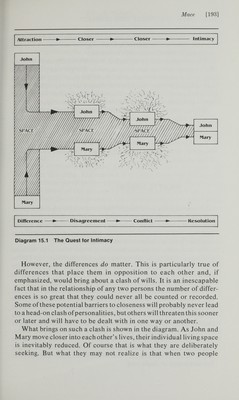
![[194] DEAL CREA TIVEL Y WITH CONFLICT (however loving they may be) get crowded together in a diminishing amount of space, they inevitably begin to get in each other's way and to frustrate some of each other's wishes. We can express this by saying that some of the differences between them surface and turn into disagreements. It is obviously impossible for any two people to want always to do the same thing in the same way at the same time. So, however tolerant they may strive to be, a point will come at which their closeness will become an irritant. And that is precisely the point at which conflict begins to appear. We see, therefore, three successive stages. First, as their living space is deliberately reduced, difference between John and Mary develops into disagreement. Then, as disagreement continues and increases, we see it develop into conflict. So, what exactly is conflict? The answer is very simple. Conflict is disagreement heated up by strong, negative emotion—and the name of the emotion is anger. WHAT IS ANGER? Like conflict, the word anger has come to have a bad reputation. It is commonly seen as a threatening, dangerous emotion that easily gets out of control. Some religious people even view it as a sinful condition which nice people should not experience. Or, if it does occur, it should be suppressed and not acknowledged. This is an unfortunate misconception. Anger is not to be confused with rage and fury although the one can—and often does—lead to the other. The word anger, however, comes from the same root as the German word angst or our own word anxiety. It means an experience of grief or pain—essentially a hurt feeling. I would define anger as the first outpost of the defense system of the ego. Most of us wish to get along smoothly and comfortably with the other people in our lives if possible and that is what we try to do most of the time. However, inevitably there are occasions when this becomes impossible. Another person invades your privacy, lets you down, puts you down, exploits your trust, or disappoints your hopes. Then your ego suffers a sense of threat and you withdraw from the relationship and go onto the defensive. We all know that first pang of anger, the awareness that the situation has taken a turn that makes us feel threatened or displeased.](https://iiif.wellcomecollection.org/image/b18037604_0197.JP2/full/800%2C/0/default.jpg)