Prevention in family services : approaches to family wellness / edited by David R. Mace.
- Date:
- [1983], ©1983
Licence: Attribution-NonCommercial 4.0 International (CC BY-NC 4.0)
Credit: Prevention in family services : approaches to family wellness / edited by David R. Mace. Source: Wellcome Collection.
198/260 page 196
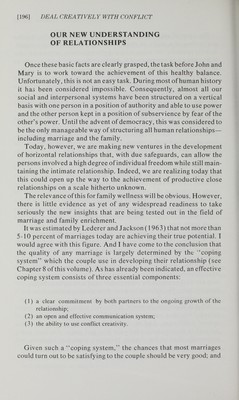
![[196] DEAL CREATIVELY WITH CONFLICT OUR NEW UNDERSTANDING OF RELATIONSHIPS Once these basic facts are clearly grasped, the task before John and Mary is to work toward the achievement of this healthy balance. Unfortunately, this is not an easy task. During most of human history it has been considered impossible. Consequently, almost all our social and interpersonal systems have been structured on a vertical basis with one person in a position of authority and able to use power and the other person kept in a position of subservience by fear of the other's power. Until the advent of democracy, this was considered to be the only manageable way of structuring all human relationships— including marriage and the family. Today, however, we are making new ventures in the development of horizontal relationships that, with due safeguards, can allow the persons involved a high degree of individual freedom while still main¬ taining the intimate relationship. Indeed, we are realizing today that this could open up the way to the achievement of productive close relationships on a scale hitherto unknown. The relevance of this for family wellness will be obvious. However, there is little evidence as yet of any widespread readiness to take seriously the new insights that are being tested out in the field of marriage and family enrichment. It was estimated by Lederer and Jackson (1963) that not more than 5-10 percent of marriages today are achieving their true potential. I would agree with this figure. And I have come to the conclusion that the quality of any marriage is largely determined by the 'coping system which the couple use in developing their relationship (see Chapter 8 of this volume). As has already been indicated, an effective coping system consists of three essential components: (1) a clear commitment by both partners to the ongoing growth of the relationship; (2) an open and effective communication system; (3) the ability to use conflict creativity. Given such a coping system, the chances that most marriages could turn out to be satisfying to the couple should be very good; and](https://iiif.wellcomecollection.org/image/b18037604_0199.JP2/full/800%2C/0/default.jpg)