Prevention in family services : approaches to family wellness / edited by David R. Mace.
- Date:
- [1983], ©1983
Licence: Attribution-NonCommercial 4.0 International (CC BY-NC 4.0)
Credit: Prevention in family services : approaches to family wellness / edited by David R. Mace. Source: Wellcome Collection.
210/260 page 208
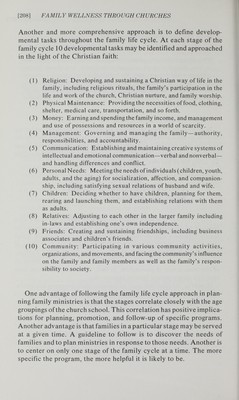
![[208] FAMILY WELLNESS THROUGH CHURCHES Another and more comprehensive approach is to define develop¬ mental tasks throughout the family life cycle. At each stage of the family cycle 10 developmental tasks may be identified and approached in the light of the Christian faith: (1) Religion: Developing and sustaining a Christian way of life in the family, including religious rituals, the family's participation in the life and work of the church, Christian nurture, and family worship. (2) Physical Maintenance: Providing the necessities of food, clothing, shelter, medical care, transportation, and so forth. (3) Money: Earningandspendingthefamily income, and management and use of possessions and resources in a world of scarcity. (4) Management: Governing and managing the family—authority, responsibilities, and accountability. (5) Communication: Establishing and maintainingcreative systems of intellectual and emotional communication—verbal and nonverbal— and handling differences and conflict. (6) Personal Needs: Meetingthe needs ofindividuals(children, youth, adults, and the aging) for socialization, affection, and companion¬ ship, including satisfying sexual relations of husband and wife. (7) Children: Deciding whether to have children, planning for them, rearing and launching them, and establishing relations with them as adults. (8) Relatives: Adjusting to each other in the larger family including in-laws and establishing one's own independence. (9) Friends: Creating and sustaining friendships, including business associates and children's friends. (10) Community: Participating in various community activities, organizations, and movements, and facing the community's influence on the family and family members as well as the family's respon¬ sibility to society. One advantage of following the family life cycle approach in plan¬ ning family ministries is that the stages correlate closely with the age groupings of the church school. This correlation has positive implica¬ tions for planning, promotion, and follow-up of specific programs. Another advantage is that families in a particular stage may be served at a given time. A guideline to follow is to discover the needs of families and to plan ministries in response to those needs. Another is to center on only one stage of the family cycle at a time. The more specific the program, the more helpful it is likely to be.](https://iiif.wellcomecollection.org/image/b18037604_0211.JP2/full/800%2C/0/default.jpg)