Prevention in family services : approaches to family wellness / edited by David R. Mace.
- Date:
- [1983], ©1983
Licence: Attribution-NonCommercial 4.0 International (CC BY-NC 4.0)
Credit: Prevention in family services : approaches to family wellness / edited by David R. Mace. Source: Wellcome Collection.
234/260 page 232
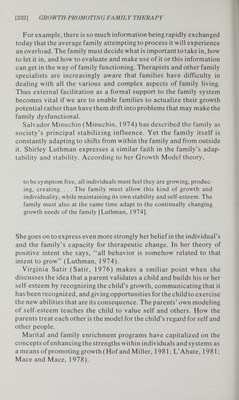
![[232] GROWTH-PROMOTING FAMILY THERAPY For example, there is so much information being rapidly exchanged today that the average family attempting to process it will experience an overload. The family must decide what is important to take in, how to let it in, and how to evaluate and make use of it or this information can get in the way of family functioning. Therapists and other family specialists are increasingly aware that families have difficulty in dealing with all the various and complex aspects of family living. Thus external facilitation as a formal support to the family system becomes vital if we are to enable families to actualize their growth potential rather than have them drift into problems that may make the family dysfunctional. Salvador Minuchin (Minuchin, 1974) has described the family as society's principal stabilizing influence. Yet the family itself is constantly adapting to shifts from within the family and from outside it. Shirley Luthman expresses a similar faith in the family's adap¬ tability and stability. According to her Growth Model theory, to be symptom free, all individuals must feel they are growing, produc¬ ing, creating. . . . The family must allow this kind of growth and individuality, while maintaining its own stability and self-esteem. The family must also at the same time adapt to the continually changing growth needs of the family [Luthman, 1974]. She goes on to express even more strongly her belief in the individual's and the family's capacity for therapeutic change. In her theory of positive intent she says, all behavior is somehow related to that intent to grow (Luthman, 1974). Virginia Satir (Satir, 1976) makes a smiliar point when she discusses the idea that a parent validates a child and builds his or her self-esteem by recognizing the child's growth, communicating that it has been recognized, and giving opportunities for the childto exercise the new abilities that are its consequence. The parents' own modeling of self-esteem teaches the child to value self and others. How the parents treat each other is the model for the child's regard for self and other people. Marital and family enrichment programs have capitalized on the concepts of enhancingthe strengths within individuals and systems as a means ofpromoting growth (Hof and Miller, 1981; L'Abate, 1981; Mace and Mace, 1978).](https://iiif.wellcomecollection.org/image/b18037604_0235.JP2/full/800%2C/0/default.jpg)