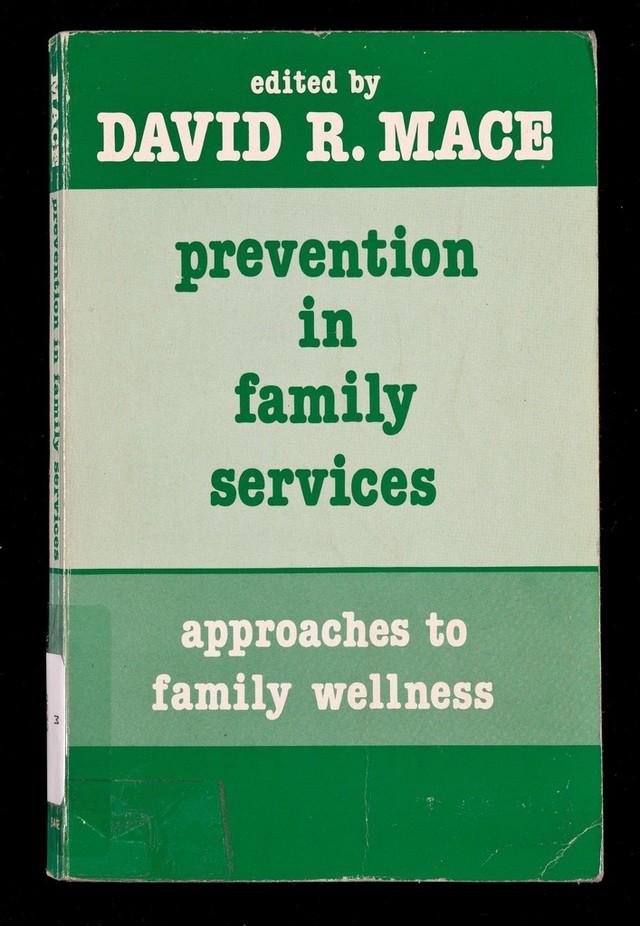
Prevention in family services : approaches to family wellness / edited by David R. Mace.
- Date:
- [1983], ©1983
Licence: Attribution-NonCommercial 4.0 International (CC BY-NC 4.0)
Credit: Prevention in family services : approaches to family wellness / edited by David R. Mace. Source: Wellcome Collection.
254/260 page 252
![[252] EPILOGUE Moreover, this would be achieved at greatly reduced cost in terms of the maintenance of legal, medical, and social services that are now rendered necessary to cope with the tragic products of the disordered and conflicted state of so many of our homes. This is not a new idea. A saying from ancient China, attributed to Confucius and variously rendered, says something like this: When there is happiness in the home there is order in the community; when there is order in the community there is prosperity in the nation; when there is prosperity in the nation there is peace in the world. Another way of putting it is that the quality of our marriages decides the quality of our families, and the quality of our families decides the quality of our communities. Can anyone seriously question this? What then stands in the way? One obstacle represents a serious concern on the part of some professionals in service agencies. It has been referred to by two of our authors—L'Abate and Guldner. There is no doubt that, at the present time, most people are not prepared to find money for preventive services, at any rate on a scale comparable with the fees they will pay for therapy. I call this phenomenon the pain-gain formula. When you are in so much trouble that you are really hurting, you will engage the services, almost regardless of the cost, that can provide treatment that will bring you relief. And this principle has also its public aspect. Money can be raised or granted by local authorities to help people who are really suffering. Prevention may be better than cure; but cure is what brings in the cash. And here I am not speaking in judgment—highly trained professionals deserve to be paid adequately for their services. There is, however, yet another obstacle in our path. It is the unwill¬ ingness of most people to acknowledge that achieving well families calls for highly developed skills which they don't naturally possess. Clark Vincent calls this the myth of naturalism—the widespread assumption that we are endowed by nature with all that it takes to achieve successful family relationships, and that to admit that we have anything new to learn is to appear stupid or incompetent. There is no doubt that this myth stubbornly survives. Indeed, it lies at the root of the pain-gain formula. It is only when we are in serious trouble that most of us become willing to acknowledge that we need help; so that, added to our hesitation to spend good money on profes¬ sional assistance, there is the view that it is also humiliatingto have to do so. It therefore becomes habitual to us to put off accepting help as long as possible—and sometimes then it is too late.](https://iiif.wellcomecollection.org/image/b18037604_0255.JP2/full/800%2C/0/default.jpg)