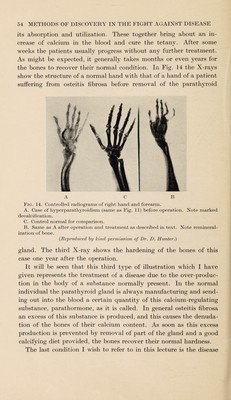
Methods of discovery in the fight against disease : Robert Boyle memorial lecture 1938 / by Sir Edward Mellanby.
- Edward Mellanby
- Date:
- [1938?]
Licence: In copyright
Credit: Methods of discovery in the fight against disease : Robert Boyle memorial lecture 1938 / by Sir Edward Mellanby. Source: Wellcome Collection.
14/20 page 50
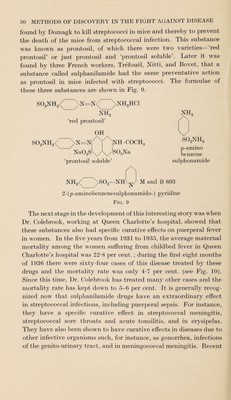
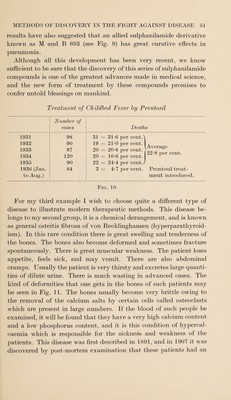
![found by Domagk to kill streptococci in mice and thereby to prevent the death of the mice from streptococcal infection. This substance was known as prontosil, of which there were two varieties—Ted prontosil’ or just prontosil and ‘prontosil soluble’. Later it was found by three French workers, Trefouel, Nitti, and Bovet, that a substance called sulphanil amide had the same preventative action as prontosil in mice infected with streptococci. The formulae of these three substances are shown in Fig. 9. S02NH2 N=N NH2HC1 NH, S02NH2 red prontosil’ OH n=n' ]NH • COCHc Na03S\^\yjS03Na ‘prontosil soluble’ NH2 A X/ so2nh2 p-amino benzene sulphonamide SOo—NH xN/ M and B 693 2-(p-aminobenzenesulphonamido-) pyridine Fig. 9 The next stage in the development of this interesting story was when Dr. Colebrook, working at Queen Charlotte’s hospital, showed that these substances also had specific curative effects on puerperal fever in women. In the five years from 1931 to 1935, the average maternal mortality among the women suffering from childbed fever in Queen Charlotte’s hospital was 22-8 per cent.; during the first eight months of 1936 there were sixty-four cases of this disease treated by these drugs and the mortality rate was only 4*7 per cent, (see Fig. 10). Since this time, Dr. Colebrook has treated many other cases and the mortality rate has kept down to 5-6 per cent. It is generally recog¬ nized now that sulphanilamide drugs have an extraordinary effect in streptococcal infections, including puerperal sepsis. For instance, they have a specific curative effect in streptococcal meningitis, streptococcal sore throats and acute tonsilitis, and in erysipelas. They have also been shown to have curative effects in diseases due to other infective organisms such, for instance, as gonorrhea, infections of the genito-urinary tract, and in meningococcal meningitis. Recent](https://iiif.wellcomecollection.org/image/b30631348_0014.jp2/full/800%2C/0/default.jpg)