Licence: Public Domain Mark
Credit: Sales catalogue 512: Maggs Bros. Source: Wellcome Collection.
326/358 page 278
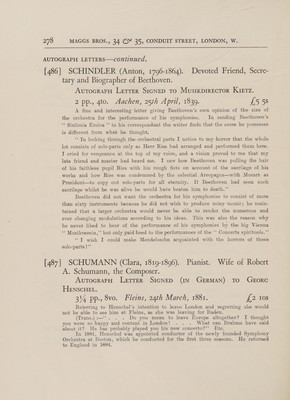
![AUTOGRAPH LETTERS—continued. [486] SCHINDLER (Anton, 1796-1864). Devoted Friend, Secre- tary and Biographer of Beethoven. AvutocrarH Lretrer SIGNED To Musikprrector KIETz. 2 pp., 4to. Aachen, 25th April, 1839. £5 5s A fine and interesting letter giving Beethoven’s own opinion of the size of the orchestra for the performance of his symphonies. In sending Beethoven’s ‘‘ Sinfonia Eroica ’’ to his correspondent the writer finds that the score he possesses is different from what he thought. ‘In looking through the orchestral parts I notice to my horror that the whole lot consists of solo-parts only as Herr Ries had arranged and performed them here. I cried for vengeance at the top of my voice, and a vision proved to me that my late friend and master had heard me. I saw how Beethoven was pulling the hair of his faithless pupil Ries with his rough fists on account of the sacrilege of his works and how Ries was condemned by the celestial Areopagus—with Mozart as President—to copy out solo-parts for all eternity. If Beethoven had seen such sacrilege whilst he was alive he would have beaten him to death.’’ Beethoven did not want the orchestra for his symphonies to consist of more than sixty instruments because he did not wish to produce noisy music; he main- tained that a larger orchestra would never be able to render the numerous and ever changing modulations according to his ideas. This was also the reason why he never liked to hear of the performance of his symphonies by the big Vienna ‘* Musikverein,’’ but only paid heed to the performances of the ‘* Concerts spirituels.”’ ‘*T wish I could make Mendelssohn acquainted with the horrors of these solo-parts !”’ [487] SCHUMANN (Clara, 1819-1896). Pianist. Wife of Robert A. Schumann, the Composer. AvutocrapH LetTTER SIGNED (IN GERMAN) TO GEORG HENSCHEL. 3% pp., 8vo. Fleins, 24th March, 1881. 7250s Referring to Henschel’s intention to leave London and regretting she would — not be able to see him at Fleins, as she was leaving for Baden. (Trans.) :— - Do you mean to leave Europe altogether? I thought you were so happy and content in London! . . . What can “Brahms have said about it? He has probably played you his new concerto?’’ Etc. In 1881, Henschel was appointed conductor of the newly founded Symphony Orchestra at Boston, which he conducted for the first three seasons. He returned ‘to England in 1884.](https://iiif.wellcomecollection.org/image/b31808463_0326.jp2/full/800%2C/0/default.jpg)
 No text description is available for this image
 No text description is available for this image
 No text description is available for this image