Quarterly report of the Edinburgh Surgical Hospital, from May to August 1829 / by James Syme.
- James Syme
- Date:
- [1829]
Licence: Public Domain Mark
Credit: Quarterly report of the Edinburgh Surgical Hospital, from May to August 1829 / by James Syme. Source: Wellcome Collection.
Provider: This material has been provided by The Royal College of Surgeons of England. The original may be consulted at The Royal College of Surgeons of England.
5/21 (page 4)
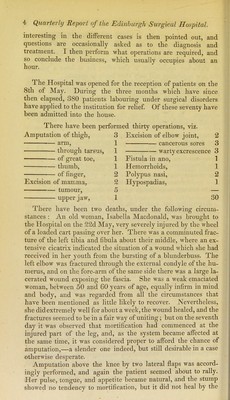
![interesting in the different cases is then pointed out, and questions are occasionally asked as to the diagnosis and treatment. I then perform what operations are required, and so conclude the business, which usually occupies about an hour. The Hospital was opened for the reception of patients on the 8th of May. During the three months which have since then elapsed, 380 patients labouring under surgical disorders have applied to the institution for relief. Of these seventy have been admitted into the house. There have been performed thirty operations, viz. Amputation pf thigh, 3 Excision of elbow joint, 2 arm, 1 cancerous sores 3 through tarsus, 1 warty excrescence 3 of great toe, 1 Fistula in ano, 1 ■ thumb, 1 Hemorrhoids, 1 of finger, 2 Polypus nasi, 2 Excision of mamma, 2 Hypospadias, ] tumour, 5 — ■ upper jaw, 1 30 There have been two deaths, under the following circum- stances : An old woman, Isabella Macdonald, was brought to the Hospital on the 22d May, very severely injured by the wheel of a loaded cart passing over her. There was a comminuted frac- ture of the left tibia and fibula about their middle, where an ex- tensive cicatrix indicated the situation of a wound which she had received in her youth from the bursting of a blunderbuss. The left elbow was fractured through the external condyle of the hu- merus, and on the fore-arm of the same side there was a large la- cerated wound exposing the fascia. She was a weak emaciated woman, between 50 and 60 years of age, equally infirm in mind and body, and was regarded from all the circumstances that have been mentioned as little likely to recover. Nevertheless, she did extremely well for about a week, the wound healed, and the fractures seemed to be in a fair way of uniting; but on the seventh day it was observed that mortification had commenced at the injured part of the leg, and, as the system became affected at the same time, it was considered proper to afford the chance of amputation,—a sleirder one indeed, but still desirable in a case otherwise desperate. Amputation above the knee by two lateral flaps was accord- ingly performed, and again the patient seemed about to rally. Her pulse, tongue, and appetite became natural, and the stump showed no tendency to mortification, but it did not heal by the](https://iiif.wellcomecollection.org/image/b22390388_0006.jp2/full/800%2C/0/default.jpg)