Flora medica : containing coloured delineations of the various medical plants admitted into the London, Edinburgh, and Dublin pharmacopœias; with their natural history, botanical descriptions, medical and chemical properties, &c. &c.; together with a concise introduction to botany; a copious glossary of botanical terms; and a list of poisonous plants, &c. &c. / edited by a member of the Royal College of Physicians, and Fellow of the Linnæan Society; with the assistance of several eminent botanists.
- Date:
- 1829-1830
Licence: Public Domain Mark
Credit: Flora medica : containing coloured delineations of the various medical plants admitted into the London, Edinburgh, and Dublin pharmacopœias; with their natural history, botanical descriptions, medical and chemical properties, &c. &c.; together with a concise introduction to botany; a copious glossary of botanical terms; and a list of poisonous plants, &c. &c. / edited by a member of the Royal College of Physicians, and Fellow of the Linnæan Society; with the assistance of several eminent botanists. Source: Wellcome Collection.
Provider: This material has been provided by the Royal College of Physicians of Edinburgh. The original may be consulted at the Royal College of Physicians of Edinburgh.
177/460
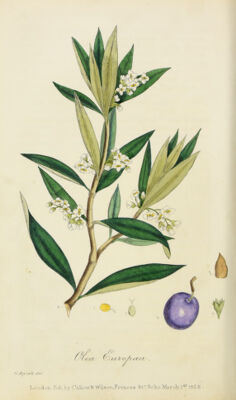
![OLEA EUROPCEA. The Olive Tree.* * * § Class Diandria.—Order Monogynia. Nat. Ord. Sepiaria:, Linn. Jasmines, Juss. Gen. Char. Corolla 4-cleft. Segments sub-ovate. Drupe one seeded. Sp ec. Char. Leaves lanceolate, entire, pale underneath. Clusters axillary, dense. This species f of olive has received its specific name either from its being a native of, or from its extensive cultivation in Europe. It is now ranked among the plants indigenous to the South of Europe; although some botanists have supposed it to be a native of Asia, but from time immemorial naturalized in Europe, where it now grows spontaneously, delighting in a rocky soil. The olive has been long cultivated in Britain;]; we find it men- tioned in the Catalogus Plantarum Horti Medici Oxouiensis, pub- lished in 1648; and when sufficiently sheltered it bears the cold of our ordinary winters tolerably well.§ This tree usually rises to the height of about twenty feet, sending off numerous long branches, covered with a bark of a greyish colour ; the leaves are firm, narrow, lance-shaped, entire, on the upper side of a bright green, beneath whitish, and stand in pairs upon short footstalks ; the flowers are small, white, numerous, and proceed in clusters near the footstalk of the leaves; the calyx is tubular, and divided at the brim into four small, erect, deciduous segments ; the corolla is a funnel-shaped petal, consisting of a short tube about the length of the calyx, and divided at the border into four semi-ovate segments; the filaments are two, tapering, opposite, and crowned * Fig. a. represents a cutting of the natural size. b. The ripe fruit. c. The pis- tillura. d. A magnified anther, e. The calyx. /. The nut. + Seven species are enumerated in the Hort. Cant. $ Since the Year 1570. Hort. Cant. § Vide Miller.](https://iiif.wellcomecollection.org/image/b21901314_0177.jp2/full/800%2C/0/default.jpg)