Flora medica : containing coloured delineations of the various medical plants admitted into the London, Edinburgh, and Dublin pharmacopœias; with their natural history, botanical descriptions, medical and chemical properties, &c. &c.; together with a concise introduction to botany; a copious glossary of botanical terms; and a list of poisonous plants, &c. &c. / edited by a member of the Royal College of Physicians, and Fellow of the Linnæan Society; with the assistance of several eminent botanists.
- Date:
- 1829-1830
Licence: Public Domain Mark
Credit: Flora medica : containing coloured delineations of the various medical plants admitted into the London, Edinburgh, and Dublin pharmacopœias; with their natural history, botanical descriptions, medical and chemical properties, &c. &c.; together with a concise introduction to botany; a copious glossary of botanical terms; and a list of poisonous plants, &c. &c. / edited by a member of the Royal College of Physicians, and Fellow of the Linnæan Society; with the assistance of several eminent botanists. Source: Wellcome Collection.
Provider: This material has been provided by the Royal College of Physicians of Edinburgh. The original may be consulted at the Royal College of Physicians of Edinburgh.
221/460
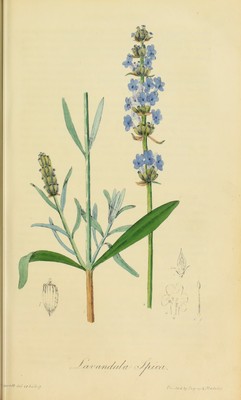
![95 are natives of southern climates ;* two of these are in general culti- vation in this country, the Lavandula Spica, (broad-leaved lavender) and Lavandula Angustifolia (narrow-leaved): these two by some botanists are considered as varieties only, but Millerf and others class them as distinct species. The Lavandula Spica is a perennial shrubby plant, much branched, and rising to the height of four or five feet; the younger branches and shoots are of a pale green, but the old woody part of the stem is brown and rough. The leaves are numerous, linear, long, narrow, entire, sessile, and of a whitish green colour ; the flowers form terminating spikes upon the young shoots, of a bright purplish colour, and consist of interrupted whorls; the calyx is ovate, and supported by a bractea; the corolla consists of a cylindrical tube, divided at the mouth into two lips, the uppermost of which is the largest, and divided into two segments, the lower is trifid, and expands downwards;] the filaments are four, enclosed within the tube of the corolla, and support small simple antherze 3 the germen is composed of four naked seeds, from which rises a slender style, supporting a bilobed stigma. Sensible and Chemical Properties. The flowers of lavender have a strong fragrant smell, the leaves are weaker and less grateful; the taste of both leaves and flowers is somewhat bitter, aromatic and pungent, heating the mouth when chewed. An infusion of the flowers is fragrant, of a reddish colour, and grows black with sulphate of iron ; alcohol extracts the qualities of lavender completely ; by distillation in water, the leaves yield a small quantity of essential oil; the flowers a much larger proportion, 15lb. yielding nearly 5 oz. of a very fragrant oil, of a greenish yellow. The foreign oil of lavender, or true oil of spike, is distilled from the tops of a different species or variety, by a quick fire. It is said, that a few drops of the oil of lavender rubbed 011 the binding of books prevent their becoming mouldy.;}; Medical Properties and Uses. Lavender has been an officinal plant a very considerable time, although we have no certain account given of it by the ancients. The medicinal virtues of lavender reside entirely in its essential oil, which experience proves to be a gentle stimulant of the aromatic kind. Dr. Cullen observes. * Nine species are enumerated in the Hort. Cant. + Vide Gardener’s Diet. t Gray’s Elements.](https://iiif.wellcomecollection.org/image/b21901314_0221.jp2/full/800%2C/0/default.jpg)