A history of botany in the United Kingdom from the earliest times to the end of the 19th century / by J. Reynolds Green.
- Date:
- 1914
Licence: In copyright
Credit: A history of botany in the United Kingdom from the earliest times to the end of the 19th century / by J. Reynolds Green. Source: Wellcome Collection.
Provider: This material has been provided by the Royal College of Physicians of Edinburgh. The original may be consulted at the Royal College of Physicians of Edinburgh.
124/672 (page 104)
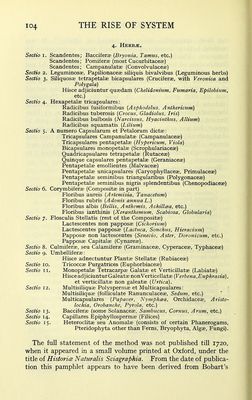
![4. Herb,®. Sectio 1. Scandentes; Bacciferae (Bryonia, Tamus, etc.) Scandentes; Pomiferae (most Cucurbitaceae) Scandentes; Campanulatae (Convolvulaceae) Sectio 2. Leguminosae, Papilionaceae siliquis bivalvibus (Leguminous herbs) Sectio 3. Siliquosae tetrapetalae bicapsulares (Cruciferae, with Veronica and Polygala) Hisce adjiciuntur quaedam (Chelidonium, Fumaria, Epilobium, etc.) Sectio 4. Hexapetalae tricapsulares: Radicibus fusiformibus (Asphodelus, Anthericum) Radicibus tuberosis (Crocus, Gladiolus, Iris) Radicibus bulbosis (Narcissus, Hyacinthus, Allium) Radicibus squamatis (Lilium) Sectio 5. A numero Capsularum et Petalorum dictas: Tricapsulares Campanulatae (Campanulaceae) Tricapsulares pentapetalae (Hypericum, Viola) Bicapsulares monopetalae (Scrophulariaceae) Quadricapsulares tetrapetalae (Rutaceae) Quinque capsulares pentapetalae (Geraniaceae) Pentapetalae emollientes (Malvaceae) Pentapetalae unicapsulares (Caryophyllaceae, Primulaceae) Pentapetalae seminibus triangularibus (Polygonaceae) Pentapetalae seminibus nigris splendentibus (Chenopodiaceae) Sectio 6. Corymbiferae (Compositae in part) Floribus aureis (Artemisia, Tanacetum) Floribus rubris (Adonis annua L.) Floribus albis (Beilis, Anthemis, Achillcea, etc.) Floribus ianthinis (Xeranthemum, Scabiosa, Globularia) Sectio 7. Flosculis Stellatis (rest of the Compositae) Lactescentes non papposae (Cichorium) Lactescentes papposae (Lactuca, Sonchus, Hieracium) Papposae non lactescentes (Senecio, Aster, Doronicum, etc.) Papposae Capitalae (Cynareae). Sectio 8. Culmiferae, seu Calamiferae (Graminaceae, Cyperaceae, Typhaceae) Sectio 9. Umbelliferae: Hisce adnectuntur Plantae Stellatae (Rubiaceae) Sectio 10. Tricoccae Purgatrices (Euphorbiaceae) Sectio 11. Monopetalae Tetracarpae Galatae et Verticillatae (Labiatae) Hisce adjiciuntur Gal eatae nonVerticellatae (Verbena, Euphrasia), et verticillatae non galeatae (Urtica). Sectio 12. Multisiliquae Polyspermae et Multicapsulares: ] Multisiliquae (folliculate Ranunculaceae, Sedum, etc.) Multicapsulares (Papaver, Nymphcea, Orchidaceae, Aristo- lochia, Orobanche, Pyrola, etc.) Sectio 13. Bacciferae (some Solanaceae, Sambucus, Cornus, Arum, etc.) Sectio 14. Capillares Epiphyllospermae (Filices) Sectio 15. Heteroclitae seu Anomalae (consists of certain Phanerogams. Pteridophyta other than Ferns, Bryophyta, Algae, Fungi). The full statement of the method was not published till 1720, when it appeared in a small volume printed at Oxford, under the title of Histories Naturalis Sciagraphia. From the date of publica- tion this pamphlet appears to have been derived from Bobart’s](https://iiif.wellcomecollection.org/image/b21909970_0130.jp2/full/800%2C/0/default.jpg)