The Goulstonian Lectures on the life-history of the malaria germ outside the human body / by Patrick Manson.
- Patrick Manson
- Date:
- [1896]
Licence: Public Domain Mark
Credit: The Goulstonian Lectures on the life-history of the malaria germ outside the human body / by Patrick Manson. Source: Wellcome Collection.
21/26
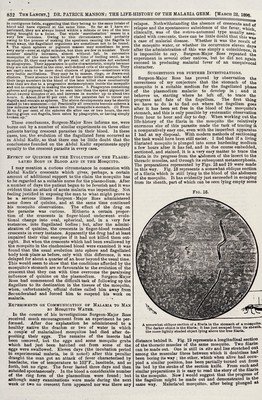
![----1 ----:—:_: • %\t (Soalstonkn ftctarts ON the life-history of the malaria r GERM OUTSIDE THE HUMAN BODY. pi. delivered before the Royal College of Physicians of London By PATRICK MANSON, M.D. Aberd., F.R.C.P. Lond., PHYSICIAN TO THE seamen’s HOSPITAL, ALBERT DOCKS ; LECTURER ON TROPICAL DISEASES AT ST. GEORGE’S HOSPITAL AND CHARING- v CROSS HOSPITAL. A |f, * - i LECTURE III.1 Delivered on March 17th, 1896. Mb. President and Gentlemen,—When some time ago I had formulated the theory enunciated in my last lecture there was little prospect of my being able personally to put it to the test of further -observation and experiment, and as neither Laveran nor Mannaberg had connected the mosquito with the flagellum, and Calandruccio had failed to observe developmental changes in malarial parasites ingested by mosquitos, I hardly ventured to hope that my views would so soon receive the support which has been given to them. Surgeon-Major Ross's Investigations. Surgeon-Major Ronald Ross, to whom I have already re¬ ferred, was in England last winter, and, beiDg favourably impressed with the mosquito hypothesis, determined to work it out on his return to India. After much discussion we fixed on a certain line of experiment and observation which my experience in former years in filaria work seemed to indi¬ cate as being likely to lead to some definite result one way or other. Those forms of malaria in which the crescent body is a prominent feature are the most suitable for experi¬ ment, at all events to commence with,^!- of all the forms of the plasmodium the crescent is the most definite, the most readily recognised in the blood, and the easiest to work with, much more so than the potential flagella- forming intra-corpuscular parasite of the quartan and benign tertian infections. We concluded that when the mosquito ingested the crescent plasmodium one of three things must happen: (#) either the crescent would be killed and digested without exhibiting any evolutional change ; or (b) ft would behave very much as crescents do on the microscope ide—that is, a large proportion of them would remain cents and a certain proportion of them would become bvals and spheres, and a very small proportion of them Would go on to flagellation ; or (c) a very large propor- ion of the crescents ingested would proceed to flagella- ton, the flagella subsequently becoming free. We con- uded that if the first turned out to be the case, then this uito hypothesis was wrong; if the second, that it was at doubtful; and if the last, that it was probably correct, at all events, that it was worth pursuing further. On his to India in April of last year Surgeon-Major Ross stationed at Secunderabad, in the Deccan, where ia is common enough. Alter some searching among hospital patients he found a complacent native, one ul Kadir, a sepoy, who was suffering from malarial ihexia, and in whose blood the crescent form of the plas- bdinm abounded; several crescents could be found in iy every field of the microscope. Surgeon-Major Ross d this man under a mosquito net, introduced mosquitos ich he had previously reared from the egg, and then col- d the insects after they had filled themselves with the .tient’s blood. He then made systematic examinations at ort serial intervals of the blood in the malariated mosquitos’ •machs, being careful at the same time to compare the ults so obtained with control slides of finger blood pared at corresponding times from the same patient, a result of a prolonged study of the subject Surgeon- !•-—~jor Ross found that, so far from being killed and digested |^y the stomach of the mosquito, with the exception of an .insignificant proportion, all the ingested crescents rapidly '^.Lectures I. and II. were delivered -on March 10th and 12th and yere published in The Lancet of March 14th and 21st respectively. proceeded in development; almost all became spheres, and at least 40 or 50 per cent, of them proceeded to flagellation and liberation of flagella ; that is to say, the crescent conducted itself in the mosquito’s stomach very much as the filaria does, and exactly as if it had got- into a proper medium for development. In explanation of some of the terms employed I may mention that the- expressions “spent spheres” and “pigment bodies” refer to the more or less passive spherical pieces of pigmented plasmodial protoplasm which remain after the flagella have- broken away from what 1 may call the mother sphere : these pieces of protoplasm represent the discarded body of the- fiagellated organism, and, biologically, may be regarded as, residual matter left after eporulation. In a letter dated May 25th, 1895, Surgeon-Major Ross says :— “ The result was my first perfect specimen of mosquito blood. About- twenty minutes had elapsed since the mosquito had begun sucking/,, the haemoglobin had commenced to diffuse. The blood swarmed with perfect spherules, not very large, about 6 microns (^= 0 006 mm.) in diameter, but showing an almost eruptive movement of pigment, as If flagella were about to burst forth in a moment. I looked in vain, how¬ ever, for flagellates; to my surprise not one was to be seen. In a very- few minutes the pigment oscillation, the intensity of which was muoh greater than in the control specimens, began to quiet down. Many of the spheres were shaking, but, as I have said, not one was flagellatew The general view, however, was very different from an ordinary specimen. All the spheres bad perfect circular contours, and ] now noticed that they seemed to be in much larger numbers than in finger blood, contrary to my first impression. Here are mv notes of the number of spheres mostly in thin fields : 7, 3, 9, .7, 1, 2, 3, 2, 2, 0, 2, 2, 1, equal to an average of 3 per field. The fields were consecutive. The numbers will give you some idea of the quantities of parasites. 1 made a specimen of a second mosquito at three-quarters of an hour after beginning to suck, and the results were precisely the.same. On counting the numbers of crescent spheres and pigment masses respectively* I obtained: First specimen : 7 crescents, 80 spheres, 8 pigment masses; second specimen, 14 crescents, 30 spheres. 9 pigment masses. On. counting the second specimen next day I found 0 crescents, 8 spheres, and 32 pigmented masses. In both specimens the number of crescents appears a great deal too favourable, as it was possible to examine field after field without finding one. Next day I began with a finger-blood specimen, which gave, when fresh, crescents and ovals 39, spheres 10, pigment masses 1. Then I made two rnOto mosquito specimens at about half an hour, my 18th and 19th mosquitos. Up to date I had observed only two flagellate bodies, both in finger blood. I was astonished I had not met with more. Always the spheres seemed ripe for flagella, but they did not come. The tem¬ perature of the air was 95° F. Now directly I looked at mosquito 18- I saw flagellated organisms in every field. I saw 9 altogether in a few minutes, but instead of counting them I wasted my time looking at them. Two fields held 2 each, and I could have found numbers, 1 db not doubt, if I had looked at once over the specimen. As it was the spectacle afforded by mosquito 18 was amazing. All the spherules seemed bursting with excitement and were exceedingly numerous. I noticed in contiguous fields 6, 10, 8, 7, 10, 14, 12, 16, an average of 10 a field; but when I came to examine special fields I found 60 in one field, 72 in the next, all endeavouring and ready to burst. I think you wili confess that no one has had such an experience as this in finger-blood. On looking through mosquito 19 I found the same swarm of spheres but no flagellate organisms. Next day I began with mosquito 20, fed the day before. I found mostly p'gment masses, but about 20 per cent, of the parasites were still cellular—that is, spheres. 1 made a specimen of a fresh mosquito—No. 21—at half an hour from feeding, with a presentiment of what I was going to see: 4 flagellates and 20 spheres in the first field, 5 flagellates and 12 spheres in the second field, and ^flagellates and 10 spheres in the third-field. Flagellate organisms e^lvwhere; one, or two, or more in every field. - 1 must have aeon over 30 or 40, though I examined only a few fields, being hardly able to tear myself away from individual organisms. * The flagella wefe excessively fine, quite invisible in open spaces, but visible in ha'irio- globinous serum. The flagellated organisms were unmistakable, because they were being dragged about all over the field generally, or were quivering and being shaken as a dog shakes a rat. Tfie ‘mani¬ festation’ nearly ceased in a few minutes, though I saw flagellates for half an hour afterwards. Mosquitos 22 and 23, at seventy and ninety- minutes, gave no flagellates and but few parasites comparatively. The- patient was put under the net again. Mosquito 24 gave the raine results at half an hour as mosquito 21. Five flagellates in one fieldof 12 parasites. Flagellate organisms everywhere, especially in open parts. The ‘manifestation’lasted in its intensity only for about five - minutes. .- .... Surgeon-Major Ross's Conclusions. Surgeon-Major Ross continued to experiment- with ifios-- quitos.goiDg over the ground again, and again generally obtaining similar results. Writing on May 28th he says “The progress of things, then, is this: 1. Almost all the crescents - are converted into spheres very shortlv after they enter the mosquito s - stomach. Sometimes a fair number of crescents may be found at ted, fifteen, twenty, or more minutes, but these are almost al ways^een in the same part of the specimen, and, therefore, belong probably to the last, intake of blood. It is very rare to find more than one or two crescents.in an entire preparation of mosquito blood made at longer intervals. Otfkls are not often seen. Untransformed crescents are, I believe, abor ted orteft. 2. The spheres are always found They have a perfect eontour,'artd contain a clear material, which distinguishes them markedly lrom the masses of corpuscles in the midst of which they are generally found. At first the pigment is clustered together; then the outermost pighaettt particles begin to oscillate; lastly, all pigment particles commence - swarming, while the whole cell may take on a slight jerk mg.movement. 3. Flagellate organisms may be found at from seven to thirty-five minutes or more. When teen they lie almost always in great numbers](https://iiif.wellcomecollection.org/image/b30476628_0021.jp2/full/800%2C/0/default.jpg)