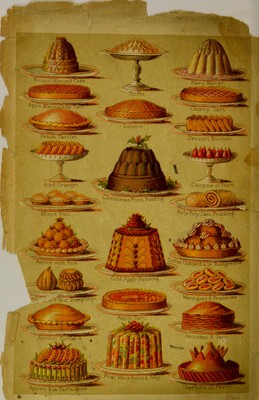
Beeton's every-day cookery and housekeeping book : comprising instructions for mistress and servants, and a collection of over sixteen hundred and fifty practical receipts. With numerous wood engravings and one hundred and forty-two coloured figures, showing the proper mode of sending dishes to table.
- Isabella Beeton
- Date:
- [1888?]
Licence: Public Domain Mark
Credit: Beeton's every-day cookery and housekeeping book : comprising instructions for mistress and servants, and a collection of over sixteen hundred and fifty practical receipts. With numerous wood engravings and one hundred and forty-two coloured figures, showing the proper mode of sending dishes to table. Source: Wellcome Collection.
Provider: This material has been provided by The University of Leeds Library. The original may be consulted at The University of Leeds Library.
487/526 (page 395)
![CABBAGE. “ Am I going to toll you bow to cook a simple cabbage, and after nil these years too ? ” No, I hope everybody, save a few obliged-to-be-left-out people know all this well enough without any interference from me. Take off the outer leaves, and remove the stalk from as nice and large a cabbage as you can obtain. Scald it in scalding water for 10 minutes. Make a cavity in the centre by the stalk, and fill it and between every leaf with forcemeat. Bind it so that it does not let this stuffing drop out, and put it in a pan with some gravy, a slice of bacon, a stick of thyme, a bay leaf, and a couple of carrots. Stew all gently together, and when done untie the string, and serve with the strained gravy round it. VEGETABLE MARROW. The marrows must be cut into pieces according to their size, and according to the size and capacity of the dish they are to be put in. Trim them very neatly after peeling them thinly. Put them in a sauti pan (deep) that is spread with butter, and add sprinklings only of nutmeg, pepper, salt, and about. 1 teaspoonful of pounded sugar, and make them moist by the addition of 1 pint of white broth. Boil very gently for 10 minutes, boil them down in their glaZe, add 2 ounces of butter, stirring it in, aud the juice of 4 a lemon. Pour this sauce over the marrow and se e. SPANISH ONIONS. Peel as usual, and force out the cores or hearts with an ordinary long vegetable cutter. Boil them in water for 10 minutes, and lay them on a cloth to drain. Spread butter over the bottom of a saute pan as in the directions for the vegetable marrow, and put in the onions. Now pour in enough gravy to cover them and boil them on a slow fire, turning them now and then. When nearly done, add 2 teaspoorrfuls of pounded sugar, boil them quite quickly to a glaze, put a little tomato sauce with them, and put them in a dish close together. [These are not a dish to be strongly recommended as part of a second course. They form an excellent garnish for braized beef, &c.] BROAD BEANS. This is a much-liked dish. Get young beans, boil them with a bunch of parsley and a teaspoonful of salt. Drain them when cooked, put them in a stewpan, with a sprinkling of pepper, nutmeg, and salt, a small bunch of chopped parsley, 2 ounces of butter, and as much winter savory as will lie on a sixpence. Shake the beans over the fire for a few minutes, and mix them with a mixture of the yolks of 4 eggs and the juice of i a lemon. SALAD. If your salad is to be an excellent ono—that is to say, an eatable one, for salads are not eatable unless they are excellent—the vegetables used in the preparation must be young and fresh, and they should be prepared only just before they are to be used. These may seem little unimportant matters, but if they are neglected your salad will be a failure, however careful you may be upon all other points. Bndive (blanched) and cos lettuce are almost the best vegetables that can bo used M a salad. Strip off the green leaves leaving nothing but the crisp white hcai la,](https://iiif.wellcomecollection.org/image/b2152807x_0487.jp2/full/800%2C/0/default.jpg)