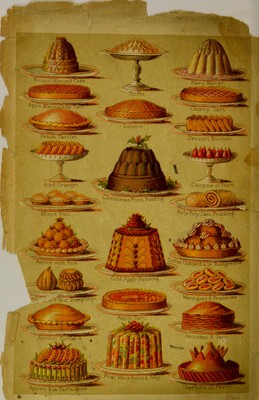
Beeton's every-day cookery and housekeeping book : comprising instructions for mistress and servants, and a collection of over sixteen hundred and fifty practical receipts. With numerous wood engravings and one hundred and forty-two coloured figures, showing the proper mode of sending dishes to table.
- Isabella Beeton
- Date:
- [1888?]
Licence: Public Domain Mark
Credit: Beeton's every-day cookery and housekeeping book : comprising instructions for mistress and servants, and a collection of over sixteen hundred and fifty practical receipts. With numerous wood engravings and one hundred and forty-two coloured figures, showing the proper mode of sending dishes to table. Source: Wellcome Collection.
Provider: This material has been provided by The University of Leeds Library. The original may be consulted at The University of Leeds Library.
488/526 (page 396)
![soo Wash these and put them in cold water for quite 1£ hour. Wipe them quite dry Add to these hearts a couple of heads of celery, and 2 anchovies (these are bette* for your purpose than essence of anchovies), and a few chives or young onions all cut small. Make the dressing of the yolks of 2 hard-hoiled eggs, with a tea- spoonful of salt and 2 of mustard mixed (a drop of assafoetida will give to the mustard a slight flavour of garlic). To every tablespoonful of vinegar add one of oil, one spoonful being impregnated with chilies. The finest oil should be used, and a little tarragon and walnut ketchup may be added if liked. Mix the dressing lightly with the salad. Put the whole preparation into your bowl, and ornament witti hard-boiled egg and boiled beet cut in slices. CARROTS. The plate represents a dish of plain-boiled carrots : each split into four quarters. RADISHES. These hardly require detailing. Choose the best possible radishes, both long and round, and also red and white. Pile them prettily, as in the Plate, on a foundation of parsley or endive. These form a pretty dish, and can hardly be left out of one’s list of “ green stuff,’’ but they contain much water, and are not con- sidered very nutritious therefore ; but they form a pleasant accompaniment with other things, and are also somewhat of a stimulating nature. C AULIFLO WERS. To dress these well cut the green part as in our illustration, and cut the stalk quite close up to the flower. Let them soak for at least an hour in cold water, and lay them in boiling milk and water (or water alone). It is done when the stalk is tender. Drain and serve with plain butter sauce separately. This is a hand- some and deservedly popular dish. GREEN PEAS. Peas should never be sent to table unless they are really and truly of a tempting autumnal green hue, nor unless they are young. Boil them as soon after shelling them as possible. Put them into a colander and let clean cold water run upon them from a tap. Salt the water slightly that they are to be placed in ; let it boil and pour in the peas. Keep the pan uncovered and boiling rapidly till they are tender. At the end of 20 minutes drain them. Pour them into their dish, put a knob of fresh butter in the centre, and add a sprinkling of pepper and salt. Stir the peas gently, not breaking them, with a wooden spoon, and serve quickly. [For a dinner party it is not advisable to boil a sprig of mint with the peas, as many persons dislike the flavour. There might, however, be two dishes served.] FRENCH BEANS. Boil as ordinarily. Put £lb. of butter into a saucepan with a sprinkling of nutmeg, pepper, and salt, the juice of a lemon, a tablespoonfu of chopped and parboiled parsley, and two chopped shalots. Put these on the fire to melt (not boil) the butter, put the beans in, shake to and fro, and dish either with or without croutons J round the dish. [For dinner parties these ways of cooking such popular 1 Vegetables are to be recommended, as they form tasteful as well as tasty dishes.}](https://iiif.wellcomecollection.org/image/b2152807x_0488.jp2/full/800%2C/0/default.jpg)