The book : its printers, illustrators, and binders, from Gutenberg to the present time / By Henri Bouchot ... With a treatise on the art of collecting and describing early printed books, and a Latin-English and English-Latin topographical index of the earliest printing places. Ed. by H. GRevel. Containing one hundred and seventy-two fac-similes of early typography, book-illustrations, printers' marks, bindings, numerous borders, initials, head and tail pieces, and a frontispiece.
- Henri Bouchot
- Date:
- 1890
Licence: Public Domain Mark
Credit: The book : its printers, illustrators, and binders, from Gutenberg to the present time / By Henri Bouchot ... With a treatise on the art of collecting and describing early printed books, and a Latin-English and English-Latin topographical index of the earliest printing places. Ed. by H. GRevel. Containing one hundred and seventy-two fac-similes of early typography, book-illustrations, printers' marks, bindings, numerous borders, initials, head and tail pieces, and a frontispiece. Source: Wellcome Collection.
Provider: This material has been provided by the Harvey Cushing/John Hay Whitney Medical Library at Yale University, through the Medical Heritage Library. The original may be consulted at the Harvey Cushing/John Hay Whitney Medical Library at Yale University.
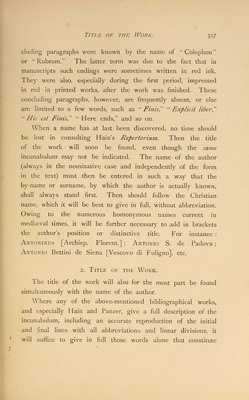
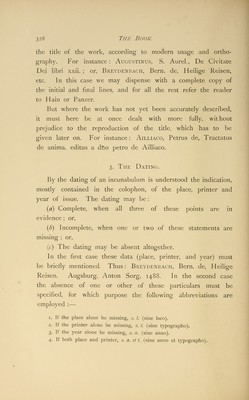
![eluding paragraphs were known by the name of Colophon or Rubrum. The latter term was due to the fact that in manuscripts such endings were sometimes written in red ink. They were also, especially during the first period, impressed in red in printed works, after the work was finished. These concluding paragraphs, however, are frequently absent, or else are limited to a few words, such as Finis Explicit liber, Hie est Finis Here ends, and so on. When a name has at last been discovered, no time should be lost in consulting Hain's Repertorium. Then the title of the work will soon be found, even though the same incunabulum may not be indicated. The name of the author (always in the nominative case and independently of the form in the text) must then be entered in such a way that the by-name or surname, by which the author is actually known, shall always stand first. Then should follow the Christian name, which it will be best to give in full, without abbreviation. Owing to the numerous homonymous names current in mediaeval times, it will be further necessary to add in brackets the author's position or distinctive title. For instance : Antoninus [Archiep. Florent.] ; Antonio S. de Padova ; Antonio Bettini de Siena [Vescovo di Fuligno], etc. 2. Title of the Work. The title of the work will also for the most part be found simultaneously with the name of the author. Where any of the above-mentioned bibliographical works, and especially Hain and Panzer, give a full description of the incunabulum, including an accurate reproduction of the initial and final lines with all abbreviations and linear divisions, it will suffice to give in full those words alone that constitute](https://iiif.wellcomecollection.org/image/b2103297x_0347.jp2/full/800%2C/0/default.jpg)