Factors affecting the coagulation time of blood. III, The hastening of coagulation by stimulating the splanchnic nerves / by W.B. Cannon and W.L. Mendenhall.
- Walter Bradford Cannon
- Date:
- [1914?]
Licence: Public Domain Mark
Credit: Factors affecting the coagulation time of blood. III, The hastening of coagulation by stimulating the splanchnic nerves / by W.B. Cannon and W.L. Mendenhall. Source: Wellcome Collection.
3/12
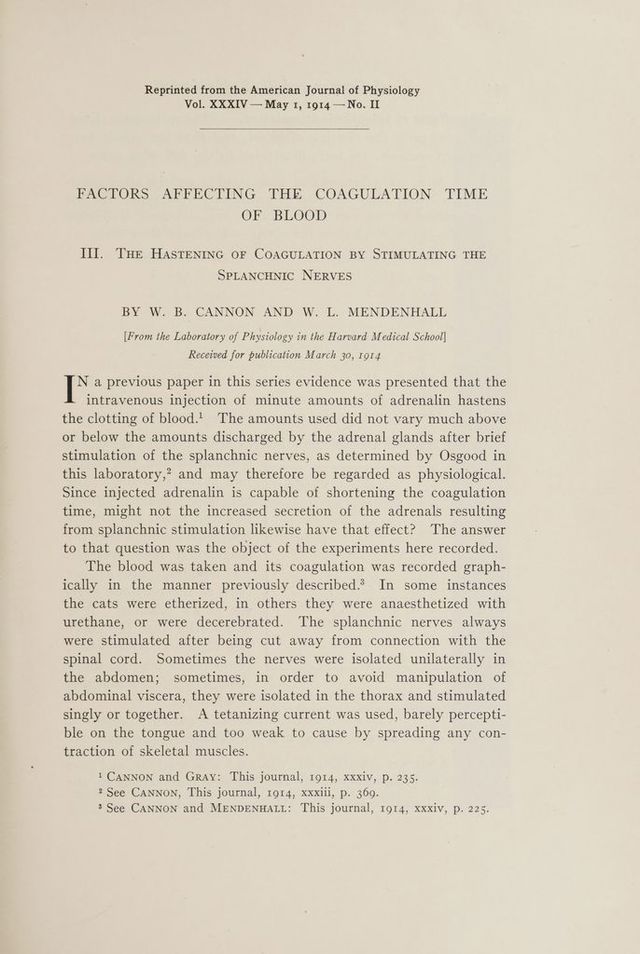
![Reprinted from the American Journal of Physiology Vol. XXXIV — May 1, 1914 —No. II PACTORS APFECTING THE COAGULATION TIME OF BLOOD III. THe HASTENING OF COAGULATION BY STIMULATING THE SPLANCHNIC NERVES BY W. B. CANNON AND W. L. MENDENHALL [From the Laboratory of Physiology in the Harvard Medical School] Received for publication March 30, 1914 N a previous paper in this series evidence was presented that the intravenous injection of minute amounts of adrenalin hastens the clotting of blood! The amounts used did not vary much above or below the amounts discharged by the adrenal glands after brief stimulation of the splanchnic nerves, as determined by Osgood in this laboratory,” and may therefore be regarded as physiological. Since injected adrenalin is capable of shortening the coagulation time, might not the increased secretion of the adrenals resulting from splanchnic stimulation likewise have that effect? The answer to that question was the object of the experiments here recorded. The blood was taken and its coagulation was recorded graph- ically in the manner previously described.2. In some instances the cats were etherized, in others they were anaesthetized with urethane, or were decerebrated. The splanchnic nerves always were stimulated after being cut away from connection with the spinal cord. Sometimes the nerves were isolated unilaterally in the abdomen; sometimes, in order to avoid manipulation of abdominal viscera, they were isolated in the thorax and stimulated singly or together. A tetanizing current was used, barely percepti- ble on the tongue and too weak to cause by spreading any con- traction of skeletal muscles. 1 CANNON and GRAy: This journal, 1914, xxxiv, p. 235. 2 See CANNON, This journal, 1914, xxxili, p. 369. 3 See CANNON and MENDENHALL: This journal, 1914, xxxiv, p. 225.](https://iiif.wellcomecollection.org/image/b33443749_0003.jp2/full/800%2C/0/default.jpg)