Licence: Public Domain Mark
Credit: Baron von Haller / J. Risdon Bennett. Source: Wellcome Collection.
Provider: This material has been provided by The Royal College of Surgeons of England. The original may be consulted at The Royal College of Surgeons of England.
17/20 page 15
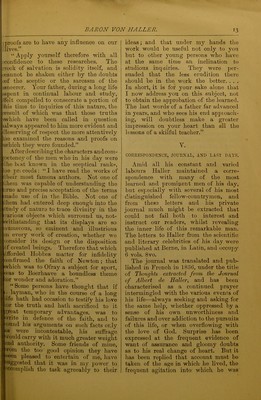
![subject the universe to • his dominion, the sectary to his rules, and the philoso- pher to his opinions. Keligion alone can teach us to look without vexation on the talents and prerogatives of our contem- |K)raries.” “ When we determine to live Its cliildren, but children eternally sub- missive to the same father, established ;for ever in a residence unapproached by envy, we can in some measure over- come ■^is innate jealousy based on our ■own yill, whose pretensions are not ,tt|j^t^ted by nature.” In 1768, when Switzerland was politi- rcally much disturbed, he writes: “I ^'Wouid fain comfort my dear friend did I Iknow how. Had it been a personal nmisfortune it would have been easy, irhere is a grandeur both in pardoning }>and suffering for faults. But the mis- IJjgrtuno here is to our country. Can we ‘36 insensible to this, and pardon the iniury done to it, as though it were a personal affair ? In this case it seems a \?ty to be afflicted, a duty to detest the .j^ffidna^of our country. , And yet He yho knew the counsels of God has made ib exception. We are to pardon all liults, to sacrifice all griefs to the con- C(fflng thought that, though inflicted j»y the hand of man, they are the strokes ff- supreme icisdom that knows neither rrror nor cruelty. . . . This evil comes rrom God. Public calamities are the lidy means of interrupting the progress (f luxuiy, arresting the advance of rreligion, the daughter of pride, that is lae offspring of prosperity.” But our limits forbid further extracts iJOm journal or corresj^ondence. V At was near the moment when he was ft^render up his spirit that Jose23h II., ■^peror of Austria, paid him a visit, w^y 17, 1777. This visit made a great W, because the Emperor refused the ^ honour to Voltaire, and passed by roey, to the intense mortification of B ])hilosoj)her. When one felicitated B illustrious old man on the distinction id him, he replied, “ Blessed only are ©y whose names are inscribed in liven.” The distinction was increased by the advice given by Maria Theresa, who had told her son to visit Haller and to avoid Voltaire. The Emperor on leaving Haller’s aj)artment said to one of his sons, “ Such a man as your father I have never known, genius allied to virtue ! What riches, what dignity in his conversation, what manly eloquence. How grievous that we are so soon to lose such a man ! I owe him two delightful hours.” On his return to Vienna he sent some choice wine and a supjDly of quinine, which, however, arrived too late —Haller having died a few days before. The Emperor was much jDained to hear of his death, and when his library was to be sold, purchased it for 2000 louis d’or and presented it to the Milan Academy. Haller wrote an account of this.visit to his friend Count Lambert but declined to have it published, and replied to the question whether it had not made him very happy—“ I am on the confines of eternity, my good fortune and my happiness are beyond the tomb; all that I have on this side is but a momen- tary affair, a house of cards, gilded if you please, but to be thrown down by an inevitable wind.” He retained his re- markable faculties to the last, and though he seems not to have entirely lost his habitual fear of death, the rod and staff of the Good Shepherd did not fail him in the valley of the shadow of death. His final words when drawing his last breath were a threefold invoca- tion to his Saviour to receive his spirit. He died on the 12th December, 1777, when Switzerland lost her most illus- trious citizen. A few days before his death he wrote his last letter to his friend Count Lambert, in which he says : “On the borders of eternity I see nothing that can assure me of my destiny, but the certainty of a Mediator who has paid my debt and given me ground to believe that God is reconciled to mo and will pardon my faults, and the mul- titude of sins of which I have been guilty during the course of a long life; for I nave entered on my 70th year.”](https://iiif.wellcomecollection.org/image/b22472204_0017.jp2/full/800%2C/0/default.jpg)




 No text description is available for this image
 No text description is available for this image
 No text description is available for this image