Volume 2
The cyclopaedia of anatomy and physiology / edited by Robert B. Todd.
- Date:
- 1836-1859
Licence: Public Domain Mark
Credit: The cyclopaedia of anatomy and physiology / edited by Robert B. Todd. Source: Wellcome Collection.
Provider: This material has been provided by King’s College London. The original may be consulted at King’s College London.
107/1034 (page 93)
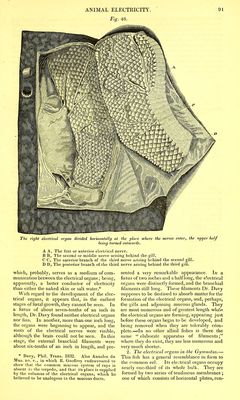
![nerve is, for the most part, divided into five distinct branches before entering the electrical organs; and these are again subdivided into, at least, as many branches as there are longi- tudinal septa. Rudolphi describes a nerve formed from branches of the fifth pair and sympathetic, which runs beneath the lateral line, over the surface of the electrical organs, but does not enter them. This has, by some, been supposed to be an electrical nerve, but without sufficient reason.* 3. The electrical organs in the Silurus.— The only organ that can be regarded as con- nected with the electrical function in this fish is a thick layer of dense cellular tissue, which completely surrounds the body immediately beneath the integuments. So compact is it that, at first sight, it might be mistaken for a deposit of fatty matter. But, under the mi- croscope, it appears to be composed of ten- dinous fibres, closely interwoven, the meshes of which are filled with a gelatinous substance. This organ is divided by a strong aponeurotic membrane into two circular layers, one outer, lying immediately beneath the corion, the other interna], placed above the muscles. Both or- gans are isolated from the surrounding paits by a dense fascia, excepting where the nerves and bloodvessels enter. The cells or meshes in the outer organ, formed by its reticulated fibres, are rhombic in shape, and very minute, so as to require a lens to see them well. The component tissue of the inner organ is some- what flaky, and also cellular. The nerves of the outer organ are branches of the fifth pair, which runs beneath the lateral line and above the aponeurotic covering of the organ. This aponeurosis is pierced by many holes for the transmission of the nerves, which are lost within the cellular tissue of the organ. The intercostals supply the inner organ : their electrical branches are numerous and remarka- bly fine.f The organs of the other known electrical fishes have not yet come under the notice of any anatomist. In taking a general view of these interesting organs, we are struck with the existence of a certain degree of analogy amongst them, and yet we fail to discover such resemblances as might be expected, and such as exist between the structures of other organs performing the same functions in different animals. Here we have tendinous membranes variously arranged, yet all so as to form a series of separate cells filled with a gelatinous matter. But how great is the difference between the large columnar cell in the torpedo full of delicate partitions, and the minute rhombic cells of the Silurus ! All, however, are equally supplied with nerves of very great size, larger than any others in the same animals; and, indeed, we may venture to say, larger than any nerve in any other ani- mal of like bulk. Abhandl. der Acad. v. Berlin, 1820-21. 229, and Blainville, Princ. d'Anat. Comp. i. 232. t Rudolphi, (Abhandl. der Acad. v. Berlin. 1824.) 140. The organs vary in different fishes ; first, in situation relatively to other organs. They bound the sides of the head in the torpedo; run along the tail of the Gymnotus, and sur- round the body of the Silurus ; secondly, in having different sources of nervous energy ; and, thirdly, in the form of the cells. No other fishes have aponeuroses so extensive, or such an accumulation of gelatine and albumen in any cellular organ. Broussonet remarked that all the electrical fishes at present known to us, although all belonging to different classes, have yet certain characters in common. All, for instance, have the skin smooth, without scales, thick, and pierced with small holes, most numerous about the head, and which pour out a peculiar fluid. Their fins are formed of soft and flexible rays, united by means of dense membranes. Neither the Gymnotus nor torpedo has any dorsal fin; the Silurus has only a small one, without rays, situated near the tail. All have small eyes.* X. Analogies of animal electricity.—Setting aside the vague hypotheses of the older philo- sophers, (some of whom attributed the phe- nomena produced by the peculiar power of electrical fishes entirely to the mechanical effect of certain rapid motions of their surface, and others to the influence of currents of minute corpuscules flowing from the body of the fish in the act of discharging,) we can have no dif- ficulty in referring this very remarkable series of phenomena to the agency of some power very analogous to common or voltaic elec- tricity, which seems to stand in the same rela- tion to these as they do to electricity derived from other sources.-f- It was by Muschenbroek that the effects of the torpedo's discharge were first referred to electricity. He was led to imagine that the agent producing the shock was truly electrical from the similarity of its effects to those of the discharge of the Leydenjar. Succeeding observations, however, as we have seen, have shewn that certain differences exist between the phenomena produced by Animal Electricity and those observed in con- nexion with the discharge of the Leyden jar : the chief of these are—its passage through air only to a very small distance; its producing only very slight igniting effects even when con- siderably accumulated; and its manifesting but feebly the phenomena of attraction and repulsion. Further, it affects the multiplier more strongly than common electricity does under ordinary circumstances, and its chemical effects are more distinct. From voltaic elec- tricity it is distinguished by the comparative feebleness of its power of decomposing water; by the greater sharpness of the shock caused by the discharge, and by the weakness of its magnetizing power. Only four of the eight experimental effects enumerated by Dr. Faradayf as characteristic * Mem. de l'Acad. de Paris, 1782. 693. t It is interesting to know that the Arabic name of the torpedo (Rausch) means also lightning. X Philos. Trans. 1833.](https://iiif.wellcomecollection.org/image/b2130046x_0002_0107.jp2/full/800%2C/0/default.jpg)