Volume 4
The cyclopaedia of anatomy and physiology / edited by Robert B. Todd.
- Date:
- 1836-1859
Licence: Public Domain Mark
Credit: The cyclopaedia of anatomy and physiology / edited by Robert B. Todd. Source: Wellcome Collection.
Provider: This material has been provided by King’s College London. The original may be consulted at King’s College London.
33/702 (page 17)
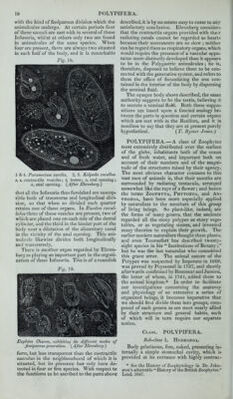
![effort, or the mere action of the vibratile cilia completes the operation, and the two young animalcules, thus formed, part company and commence an independent existence. The direction of the line of separation varies in different species, and even in individuals of the same species (17. 4, 5, 6, 7, 8) ; some- times it is transverse, sometimes oblique, and in other cases it traverses the long axis of the body, where the form of the animalcule is elongated or oval. This method of reproduction is ex- ceedingly prolific; for, as each successive gene- ration arrives at maturity in the course of a few hours, and undergoes the same process of divi- sion, it will be found on computation that the progeny derived from a single animalcule may, in the course of a single month, amount to many hundred millions in number. In the Vorticellte and allied forms supported by rigid or flexible pedicles the fissiparous pro- cess is essentially similar. The adult bell {fig. 9, fl) preparatory to its division becomes considerably extended in a lateral direction {b), in which condition the line of fissure is in- dicated, extending from the mouth of the bell to the point of its connection with the pedicle. An indentation soon appears which, progres- sively extending downwards, soon separates the original animalcule into two, both of which are attached to the stem (c, d). In a short time one or both break loose; in the former case the stem survives, in the latter it perishes. The detached bells speedily assume a new form (e,f), and might easily be mistaken for a totally different genus swinnning about by means of cilia situated at both extremities of their barrel-like bodies. At last, having found a fit support, they fix themselves to it, the attached extremity becoming gradually elon- gated into a delicate irritable filament similar to that which they possessed prior to the com- mencement of the fissiparous process. Gemmipavous reproduction. — Besides the above mode of increase, many of the Vorti- cellas and similarly organized forms throw out little gemmae or lateral buds in the same man- ner as the Hydros and some other Polypes, which, as they advance to maturity, assume the form of the parent stock, from which they at length become detached, or else remain asso- ciated with the original from whence they sprung. Sporiferous reproduction. — The gastric vesi- cles of the Polygastria occupy but a small proportion of the interior of their minute bodies ; the rest is partially filled up with a granular tissue, which seems made up of nu- cleated cells, or, in other words, of sporules or spawn, the germs of future progeny ready to be called into active existence when liberated from the nidus in which they were generated. In Kolpoda cucullus {fig. 18, 3), these spo- rules are represented in the act of becoming discharged from the parent animalcul?e. In many species of animalcules it is easy, with the assistance of a good glass, to per- ceive in the interior of their bodies certain isolated sacculi endowed with very remarkable powers of contraction and of dilatation ; this VOL. IV. is repeated at regular intervals ; and so great is the contractile force that the little sac seems entirely to disappear, and then in a short time slowly dilating regains its former size. These sacculi Ehrenberg at first thought to be sto- machal cavities, which the creature could alternately fill and empty ; but subsequent observations convinced him that they were or- gans of a peculiar character. By slightly com- pressing large specimens, such as Paramecium aure/ia, he further observed that these con- tractile vesicles were generally two (sometimes three) in number, occupying determinate situ- ations in the creature's botly, and that from each of these a number (eight) of little canals were given off like rays from a centre towards the circumference of the body. These canals became gradually enlarged as the sacculus con- tracted ; and vice versa, when the vesicle dilated the canals shrunk and disappeared. Each canal is slightly enlarged at its origin from the central cavity, and the whole apparatus has the appear- ance of two little Op/iiuri, or thin-rayed star- fishes, enclosed in the body of the animalcule (fig. 18, 1 <5t 4, s, s). The contractile sacculi were seen by Ehrenberg in at least four-and- twenty different species of Polygastrica; but the radiating canals were detected in two only, viz. Paramecium and Ophri^oglena, Fi^. 17. '1^ 1,2. Spirostomum cirens. 3. Glaucoma sci7itilla7is. 4, 5, G, 7, 8. Glaucoma scintillans in progress of Jissiparous reproduction, sJiowing its different modes ofjissure. {^After Ehrenberg.^ These organs exhibit, both in their number and situation, important differences in different species. In Paramecium aure/ia, Paramecium caudatum, Leucophrys sanguinea, Trachelius anas, Bursaria vernalis, and Stentor ]\Iu//eri, two of them are found, one situated in the middle of the anterior, and the other in the middle of the posterior, halves of the animal. All the above species, with the exception of Stentor, multiply by spontaneous transverse division, and when thus divided each portion retains one of the contractile organs, and thehr being thus double seems to have some relation c](https://iiif.wellcomecollection.org/image/b2130046x_0004_0033.jp2/full/800%2C/0/default.jpg)