Volume 4
The cyclopaedia of anatomy and physiology / edited by Robert B. Todd.
- Date:
- 1836-1859
Licence: Public Domain Mark
Credit: The cyclopaedia of anatomy and physiology / edited by Robert B. Todd. Source: Wellcome Collection.
Provider: This material has been provided by King’s College London. The original may be consulted at King’s College London.
97/702 (page 81)
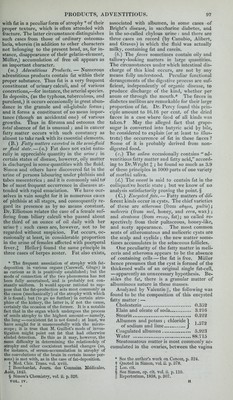
![the oxide formed the cortex of a uric acid nu- cleus ; in the others it was the sole ingredient. Unger has discovered minute traces of a sub- stance which he considers closely allied to, if not identical with, xanthin in guano: its pre- cise chemical relations, however, appear to be as yet not fully determined. Observations are wanting concerning the characters of uric oxide sediments : Berzelius says they are pulverulent and grey. 9. The carbonate of lime calculus, very rare in man, is not uncommon in graminivorous animals. Dr. Prout has seen some small cal- culi from the human subject consisting of this salt, of perfectly white colour and very friable. The carbonate may, however, be impure, and the mass accordingly vary in colour from yel- low to brown and red. This species has been observed by Smith with the appearance of a mulberry calculus*, by Brugnatelli, Fromm- herz, Walther, Loir, and others. Wood f has described two of pearly, and llampold % one of metallic lustre. 10. Carbonate of magnesia, according to Berzelius, very probably exists in all calculi composed of carbonate of lime. It appears to have been actually detected in two instances only, — once by Moscati, once by Lindbergson. 11. Urate ofmagyiesia has been found form- ing the chief mass of two calculi by Scharling; urate of ammonia was likewise present. 12. Urates of soda, potassa, and lime, never foiHu the entire mass of a calculus. The former was found in large quantity by Lindbergson in the calculus just referred to. It is uncertain whether urate of soda exists naturally in the urine; it occurs in association with uric acid and urate of ammonia in sediments, as already mentioned. 13. Phos2:>hate of magnesia is, according to Brugnatelli, of common occurrence, either mixed with triple phosphate, or forming alter- nate layers with it. 14. Chloride of sodium never forms the sub- stance of calculi, and the conditions under which this salt crystallizes in the urine are not well ascertained : partial evaporation of the fluid must first take place. The crystals are octahedral, and have their planes indented like steps of stairs. The nature of the so-called fibrinous calcu- lus (originally described by Dr. Marcet) has been made matter of question by Berzelius. It appears that the material supposed to be fibrin by that analyst was soluble, though not readily so, in nitric acid,—a character not be- longing to either fibrin or albumen. This, with other of its properties as detailed by Marcet, leads Berzelius to regard the matter as inspis- sated vesical mucus. The Museum of University College contains a fibrinous calculus taken from the bladder of a cow {fig. 85). It is of irregular elon- gated shape, measuring two and a half by one and a half inches; very light ; elastic ; of * Med. Chirurg. Trans, vol. ix. p. 14. t ]Med. and Phys. Jomii. vol. Ivii. j Schmidt's Jahrbuch, B. v. S. 379. VOL. IV. brownish grey colour internally, whitish exter- nally, and coated with a white earthy crust. Fig. 85. Section of fibrinous calculus. A new substance has recently been added to the hst of constituents of urinary calculi by Heller*, under the title of urostealiih. This substance is said to form a soap with alkalies, and to have been discharged in small masses varying in size from that of a hemp seed to that of a small nut. Each particular division of the urinary pas- sages is the seat occasionally of calculous for- mations, and the characters of these are in each site more or less peculiar. Into the description of these characters we cannot here enter seri- atim ; of the varieties thus depending upon the seat of the product — namely, renal, ureteral, vesical, prostatic, urethral, and jirceputial, — the most important, the vesical, may be considered to have been specially kept in view in the pre- ceding pages. As respects renal calculi we must content ourselves with illustrating by a figure {fig. 86) the curious branched form Fig. 86. they sometimes assume, as they gradually mould themselves to the interior of the pelvis and infundibula. Renal calculi sometimes attain great bulk. Among numerous examples of the fact we may refer to a case seen by Wilsonf, in which the kidney, perfectly atrophous, and replaced by a raultilocular membranous sac (the dilated pelvis and infundibula) contained an oxalate of lime calculus weighing seven ounces and a half. Renal calculi derive much of their prac- tical interest from their tendency to produce such atrophy of the kidney, with pyelitis (U. C. Mus.) or, more rarely, hydronephrosis. * In seinem Archiv, Bd. ii. t Lectures, p. 122. G](https://iiif.wellcomecollection.org/image/b2130046x_0004_0097.jp2/full/800%2C/0/default.jpg)