[Report 1913] / Medical Officer of Health, Newton-in-Makerfield U.D.C.
- Newton-le-Willows (England). Urban District Council.
- Date:
- 1913
Licence: Attribution 4.0 International (CC BY 4.0)
Credit: [Report 1913] / Medical Officer of Health, Newton-in-Makerfield U.D.C. Source: Wellcome Collection.
41/42 page 42
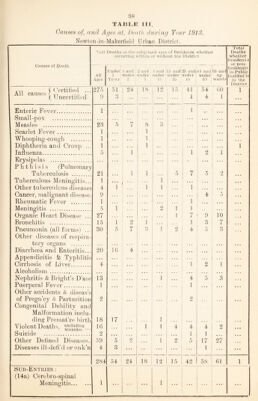
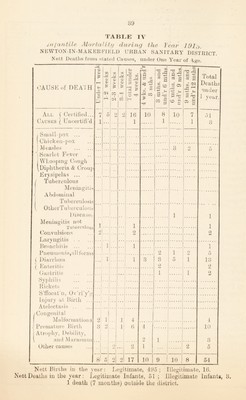
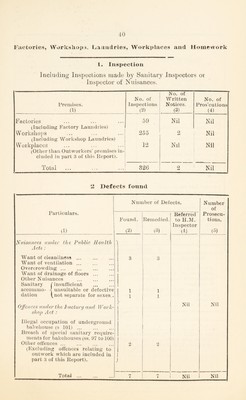
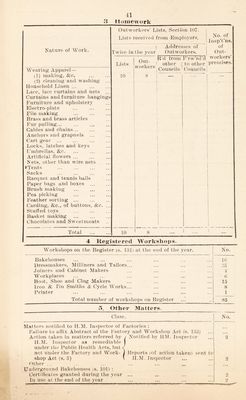
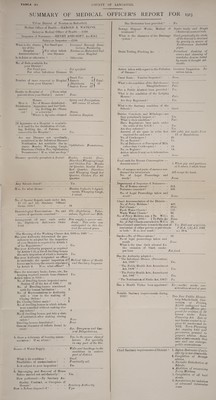
![TABLiE (C> COUNTY OF LANCASTER. SUMMARY OF MEDICAL OFFICER’S REPORT FOR 1913 __Url an District of Newton-in-Makertiold. Medical Officer of Health:—HAROLD E. WATKINS. Salary as Medical Officer of Health :—£100. Inspector of N ub.m<vs : 11KN RA ASHCROFT, Ass.R.S.I. Salary ns Inspector:—£100, What is the charac- t For Small-pox - Liverpool Borough Sana- ter of the * tonum, Fazakerley. Hospital \ For other infect- Newton-in-Maker field Isol- Accommodation ? \ ions Diseases at ion Hospital LsitJointorothcrwi.se ? Otherwise. No. of Reds available for your District ? For Small-pox ... Nut specified. For other Infectious Diseases 20. 1 Small Pox 0 \ Number of cases removed to Hospital ) Enteric 2( Total: from your District ? j ^Diphtheria 18 t 87 f Scarlet Fever 07 ) Deaths in Hospital of j From what patients from your Dist’ct ( causes? None Houses - Spray and Fumigation. How is | No. of Houses disinfected - 491) rooms. 17 schools Disinfection . +Apparatus used for Cloth- carried ing, Bedding, &c. (Steam out ? I or 0'Tierwise ? - Steam. v Where is Ap’ ratus situated Isolation Hospital. *If Apparatus {it a Hospital is available is it used for the disinfection of Cloth¬ ing, Bedding, &c., of Patients not removed to the Hospital ? - - - Yes. Are any Diseases not specifically mentioned in the Infectious Diseases Notification Act notifiable (for in¬ stance, Measles, Whooping Cough, Diarrhoea, Chicken Pox, Ophthalmia Neonatorum) ? If so, what are they ? Ophthalmia Neonatorum. Diseases specially prevalent Sz Period? Measles, Scarlet Fever, Diarrh tea, Wh oopi n g Cough and Chicken Pox. Measles 1st Quarter, Scarlet Fever 2nd Quarter, Diarrhata and Whooping Cough, 3rd Quarter, Chicken Pcx 4th Quarter. Any Schools closed 1 Yes. If so, for what disease ? - Measles, 5 schools, 9 depart¬ ments, Whooping Cough, 1 school. No. of Special Reports made under Art. 19 (15 and 10) Sanitary Officers’ Order, 1910? - • ■ 10 Bacteriological Examinations. No. and nature of specimens examined ? - 170—-Diphtheria, Tuber¬ culosis, Typhoid and Milk. Arrangement (if any) made under the Diphtheria Anti-toxin Order 1910 - ... - Free supply to poorer resi¬ dents. This order was anticipated, in this dis¬ trict for several years. ‘The Housing of the Working Classes Act, 1890 to 1909 — Has your Authority determined the pro¬ cedure to be adopted for the inspection of your District as required by Article 1 of the Regulations ? - Yes. Has your Authority prepared, as required by Article 1 (3), a list of dwelling-houses the early inspection of which is desirable Fes. Has your Authority designated an officer \ to undertake the special inspection of [ Medical Officer of Health houses and to keep the records stipulated I and Sanitary Inspector by Article 2. If so, what officer? - J Have the necessary books, forms, etc., for keeping required records been obtained Action taken in 1913 — No. of Dwelling-houses inspected under Section 17 of the Act of 1909. ? No. of Dwelling-houses considered unfit for human habitation ? - No. of Representations to Authoiity with a view to the making of Closing Orders ? - Do. Closing Orders made ? No of dwelling houses in which defects were remedied without making clos¬ ing orders ? - No of dwelling houses put into a state of habitation after making closing orders ? Dwelling houses demolished ? General character of defects found to exist ? - 32. 2. 2. 2. 4 None. None Aye, Dampness and. Gen¬ eral Dilapidations, Is there a deficiency of housing accom- Yes, in the poorer class of modation ? If so, where? - - houses. Not specially in any part of the Dis- Source of Water Supply. What is its condition ? Possibilities of contamination y Is it subject to your inspection? Wells and headings in the sandstone in eastern part of district. Good. Practically nil. Yes. Is Scavenging and Removal of House Refuse carried out satisfactorily ? - IVs. How performed:—By Sanitary Au¬ thority, Contract, or Occupiers of Houses?.Sanitary Authority. How is Refuse disposed of ? - Tips. Has Destructor been provided ? No. Sewage Disposal Works, Method of treatment ? Septic tanks and Single ( Bacterial) contact beds. What is the character of the Drainage rystem ? - Good, practically the whole of the district is drained by gravity in sewers of E< > rth e v vxi re Socket ted Drain Testing, Flushing, &c. pipes. Periodical flushing of sewers and cleaning of manholes, drains tested by smoke if thought ad¬ visable. Action taken with regard to the Pollution of Streams ? - Constant Inspection. No action taken. Canal Boats: Number Inspected ? None. What is thecondition of the Bakehouses? „ „ „ Slaughterhouses ? Good. Fair. Has a Public Abattoir been provided ? Yes. What is the condition of the Lodging Houses ? - Fair. Are they Registered ? - - - Yes. What is the Sanitary condition of the Schools ? - - - Good. Dairies, Cowsheds, and Milkshops—are they periodically inspected ? What is their condition ? - Have Regulations been made under the order of the LG.B. ? - - Are they enforced ? - Amount of air space in cubic feet required for each cow ? - No. of Cowkeepers ? - - - No.on Register? - No. of Dairymen or Purveyors of Milk (other than Cowkeepers) ? No. on Register ? - Action taken (it any) as to tuberculous milk - Yes. Yes. 800 cubic feet render Part 11. of Regulations. 20. 15. 14. 14. i\ one Food unlit for Human Comsumption :— Amount seized ? - - - - 1 Whole pig and portions of 3 others, 1 whole beast No. of carcases and parts of carcases con¬ demned for tuberculosis - - All except the beast. No. of Legal Proceedings and result ? ----- None. Department of Inspector of Nuisances— No. of Notices served ? - - - 312. Nuisances remedied ? - 509. No. of Legal Proceedings taken and o o result ? None. Closet Accommodation of the District— No. of Privy Middens ? - - - 409. Pail Closets ? ----- 2731. Fresh Water Closets ? 557. Waste Water Closets ? 30. No. of Privy Middens con- f To W.C.’s 41. verted during 1913 ? ( To Pails, &c None. No. of Pail Closets converted to W.C.’s 13. Does Council contribute towards the cost of Fes. Half-cost of privies. conversion of either privies or pail closets P.H,A. [A] Act, 11*07 or both ? If so, how much ? - - sec 39-4. Smoke—No. of Observations ? - - 12. No of legal proceedings taken and result - None What is the time limit allowed for the emission of black smoke per hour - . • Not fixed Has the Authority adopted— “ The Infectious Disease (Prevention) Act, 1890”? - . . . Yes. “ The Public Health Acts Amendment Act, 1890”?.Yes. “ The Public Health Acts, Amendment Act, 1907 ” ? - Yes. “ The Notification of Births Act, 190 7? No. Has a Health Visitor been appointed? No-—matter under con¬ sideration at en d of year Notable Sanitary improvements during 1913 ? - - - - - - Two Tew Public Elemen¬ tary Schools built. Con¬ version of Privies. £1,000 authorized loan to complete•fjftans pre¬ pared for erection of 30 houses under Town Planning Act. Row of new houses erected to re¬ place l(i condemned in 1912. Town Planning Act enquiry held and permission granted to prepare scheme. Home- older streets remade One new and one enlarged, public conveniences. Chief Sanitary requirements of District ? 1. Refuse Destructor if suit¬ able tip is not obtainable. 2. Completion of Sewage scheme. 3. Periodic Disinfection at Schools. 4. Abolition of remaining Privy Middens. 5. Completion of all back streets. 0. Sanatorium for isolation of advanced tubercular cases](https://iiif.wellcomecollection.org/image/b29910055_0041.jp2/full/800%2C/0/default.jpg)