Mechanical dentistry : a practical treatise on the construction of the various kinds of artificial dentures, comprising also useful formulae, tables and receipts for gold plate, clasps, solders, etc. / by Charles Hunter.
- Hunter, Charles.
- Date:
- 1895
Licence: Public Domain Mark
Credit: Mechanical dentistry : a practical treatise on the construction of the various kinds of artificial dentures, comprising also useful formulae, tables and receipts for gold plate, clasps, solders, etc. / by Charles Hunter. Source: Wellcome Collection.
Provider: This material has been provided by The University of Leeds Library. The original may be consulted at The University of Leeds Library.
48/356 page 28
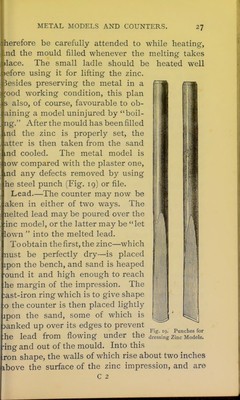
![if slightly inclined so as to facilitate parting, the; lead is poured. To obtain a counter by the other method, the lead is melted and poured into a suitable irom shape, and the zinc, held in the hand or by plierssi teeth downwards, is imbedded to the extenttie required, in the melted metal, and held in position! until the latter sets. Or the lead having beem melted in a ladle, the zinc may at once be sunk im it, while so held, until the impression is sufficiently imbedded. When set, the lead counter is struck; from the ladle, and, being of the same shape as thee latter, it forms what some consider a most con- venient reverse, especially where it is the customi to do much of the striking upon the knee or in the:» hand. We prefer to make the counter in the manner first described; it need take no more time: than the others, and a good one is perhaps obtained with more certainty. When the metal models have been cooled inr water, they may then be separated by striking: the zinc on opposite sides with the bench hammer The shrinkage of zinc interferes more or les<- with the perfect fitting of plates, and some dentisti have tried what are called fusible metals, whicr have much less shrinkage than zinc. There an objections to the use of the fusible metal models however, of another kind, which render them un- suitable, so that in regular practice zinc is stil employed as the best metal from which the die] can be made. The following particulars witl regard to fusible metals are given by Professo: Austen;](https://iiif.wellcomecollection.org/image/b21504283_0048.jp2/full/800%2C/0/default.jpg)
 No text description is available for this image
 No text description is available for this image
 No text description is available for this image