Licence: Public Domain Mark
Credit: On whitlow / by W. Morrant Baker. Source: Wellcome Collection.
Provider: This material has been provided by The Royal College of Surgeons of England. The original may be consulted at The Royal College of Surgeons of England.
3/12
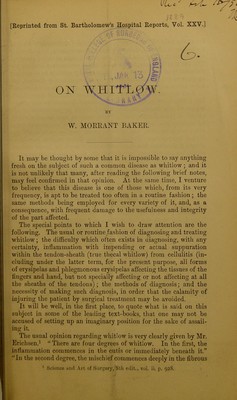
![t'Ll, c [Reprinted from St. Bartholomew’s Hospital Reports, Vol. XXV.] It may be thought by some that it is impossible to say anything fresh on the subject of such a common disease as whitlow ; and it is not unlikely that many, after reading the following brief notes, may feel confirmed in that opinion. At the same time, I venture to believe that this disease is one of those which, from its very frequency, is apt to be treated too often in a routine fashion ; the same methods being employed for every variety of it, and, as a consequence, with frequent damage to the usefulness and integrity of the part affected. The special points to which I wish to draw attention are the following. The usual or routine fashion of diagnosing and treating whitlow; the difficulty which often exists in diagnosing, with any certainty, inflammation with impending or actual suppuration within the tendon-sheath (true thecal whitlow) from cellulitis (in- cluding under the latter term, for the present purpose, all forms of erysipelas and phlegmonous erysipelas affecting the tissues of the fingers and hand, but not specially affecting or not affecting at all the sheaths of the tendons); the methods of diagnosis; and the necessity of making such diagnosis, in order that the calamity of injuring the patient by surgical treatment may be avoided. It will be well, in the first place, to quote what is said on this subject in some of the leading text-books, that one may not be accused of setting up an imaginary position for the sake of assail- ing it. The usual opinion regarding whitlow is very clearly given by Mr. Erichsen.1 “There are four degrees of whitlow. In the first, the inflammation commences in the cutis or immediately beneath it.” “In the second degree, the mischief commences deeply in the fibrous \ : ■ ^ jt£} ON WHlTLO'W. BY W. MORE ANT BAKER.](https://iiif.wellcomecollection.org/image/b22453611_0003.jp2/full/800%2C/0/default.jpg)