Ladies' manual of practical hydropathy (not the cold water system) ... / by Mrs. Smedley.
- Smedley, Caroline Anne, Mrs.
- Date:
- 1873
Licence: Public Domain Mark
Credit: Ladies' manual of practical hydropathy (not the cold water system) ... / by Mrs. Smedley. Source: Wellcome Collection.
174/434 (page 154)
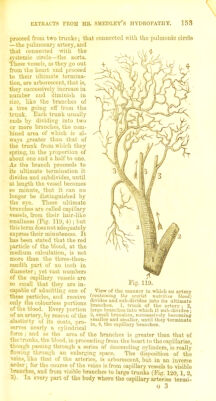
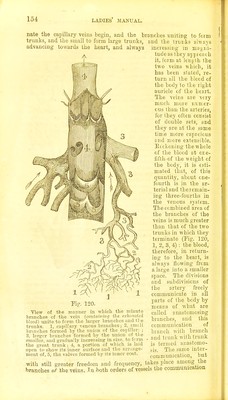
![nate the capillary veins begin, and the branches uniting to foirn trunks, and the small to form large trunks, and the trunks always advancing towards the heart, and always increasing in magni- ^ tudeastbey aj jooath it, foim at length 1be two veins which, it has been staled, re- turn all the bJocd of the body to the right auricle of the heart. The veins aie -ury much moie numer- ous than the arteries, for they often consist of double sets, and they are at the same time more capacious and more extensible. Reckoning the'w hole of the blood at one- fifth-of the v eight of the body, it is esti- mated that, of this quantity, about one- fourth is in the ar- terial and theremain- ing three-fourths in the venous system. The combined area of the branches of the veins is much greater than that of the two trunks in which they terminate (Fig. 120, 1, 2, 3, 4): the blood, therefore, in return- ing to the heart, is always flowing from a large into a smaller space. The divisions and subdivisions of the artery freely communicate in all parts of the body by means of what are called anastomosing branches, and this communication of branch with branch and trunk with trunk is termed anastomo- sis. The same inter- communication, but with still greater freedom and frequency, takes place among the branches of the veins. In i>c-th orders of vessels the communication Tie. 120. View of tbe innrmer in which the minute branches of the vein (contawiiiifl the nchamloi Hood) unite to form the larger branches and ti e trunks. 1, capillary -venous broncbes; 2, smi 11 brunches formed by the union of the capillar] i 3, larger branches formed by the union of the smaller, and gradually increasing in size, to form the gTeat trunk ; 4, a portion of which is laid open to show its inner surface and the arrange- ment of, 5, the valves formed by its inner coat.](https://iiif.wellcomecollection.org/image/b20398669_0174.jp2/full/800%2C/0/default.jpg)