Hereditary genius : an inquiry into its laws and consequences / by Francis Galton.
- Francis Galton
- Date:
- 1869
Licence: Attribution-NonCommercial 4.0 International (CC BY-NC 4.0)
Credit: Hereditary genius : an inquiry into its laws and consequences / by Francis Galton. Source: Wellcome Collection.
58/424 (page 22)
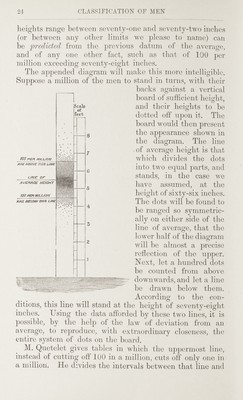
![22 CLASSTFICATIO]N OF MEN instruction, have been taught to conform to social and moral law, and rendered capable of order, of good feel¬ ing, and of working like the third of an average man. He says that more than forty per cent, have become capable of the ordinary transactions of life, under friendly control; of understanding moral and social abstractions, and of working like two-thirds of a man. And, lastly, that from twenty-five to thirty per cent, come nearer and nearer to the standard of manhood, till some of them will defy the scrutiny of good judges, when com¬ pared with ordinary young men and women. In the order next above idiots and imbeciles are a large number of milder cases scattered among private families and kept out of sight, the existence of whom is, however, well known to relatives and friends ; they are too silly to take a part in general society, but are easily amused with some trivial, harmless occupation. Then comes a class of whom the Lord Dundreary of the famous play may be considered a representative ; and so, proceeding through successive grades, we gradually ascend to mediocrity. I know two good instances of hereditary silliness short of imbecility, and have reason to believe I could easily obtain a large number of similar facts. To conclude, the range of mental ролуег between— I will not say the highest Caucasian and the lowest savage—but between the greatest and least of English intellects, is enormous. There is a continuity of natural ability reaching from one knoivs not what height, and descending to one can hardly say what depth. I propose in this chapter to range men according to their natural abilities, putting them into classes separated by equal degrees of merit, and to show the relative number of individuals included in the several classes. Perhaps some person might be inclined to make an offhand guess that the number of men included in the several classes would be pretty equal. If he thinks so, I can assure him he is most egregiously mistaken. The method I shall employ for discovering all this is an application of the very curious theoretical law of deviation from an average. First, I will explain](https://iiif.wellcomecollection.org/image/b18030452_0059.JP2/full/800%2C/0/default.jpg)