The relations of pain to weather : being a study of the natural history of a case of traumatic neuralgia / by S. Weir Mitchell.
- Silas Weir Mitchell
- Date:
- [1877]
Licence: Public Domain Mark
Credit: The relations of pain to weather : being a study of the natural history of a case of traumatic neuralgia / by S. Weir Mitchell. Source: Wellcome Collection.
Provider: This material has been provided by The Royal College of Surgeons of England. The original may be consulted at The Royal College of Surgeons of England.
3/28 page 1
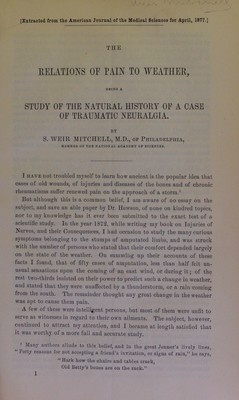
![[Extracted, from the American Journal of the Medical Sciences for April, 1877.] THE RELATIONS OF PAIN TO WEATHER, BEING A STUDY OF THE NATURAL HISTORY OF A CASE OF TRAUMATIC NEURALGIA. BY S. WEIR MITCHELL, M.D., of Philadelphia, MEMBER OF THE NATIONAL ACADEMY OF SCIENCES. I have not troubled myself to learn how ancient is the popular idea that cases of old wounds, of injuries and diseases of the bones and of chronic rheumatisms suffer renewed pain on the approach of a storm.1 But although this is a common belief, I am aware of no essay on the subject, and save an able paper by Dr. Hewson, of none on kindred topics, nor to my knowledge has it ever been submitted to the exact test of a scientific study. In the year 1872, while writing my book on Injuries of Nerves, and their Consequences, I had occasion to study the many curious symptoms belonging to the stumps of amputated limbs, and was struck with the number of persons who stated that their comfort depended largely on the state of the weather. On summing up their accounts of these facts I found, that of fifty cases of amputation, less than half felt un- usual sensations upon the coming of an east wind, or during it; of the rest two-thirds insisted on their power to predict such a change in weather, a,nd stated that they were unaffected by a thunderstorm, or a rain coming from the south. The remainder thought any great change in the weather was apt to cause them pain. A few of these were intelligent persons, but most of them were unfit to serve as witnesses in regard to their own ailments. The subject, however, continued to attract my attention, and I became at length satisfied that it was worthy of a more full and accurate study. Many authors allude to this belief, and in the great Jenner’s lively lines, F oity reasons lor not accepting a Iriend’s invitation, or signs of rain,” he says, “ Hark how the chairs and tables crack, Old Betty’s bones are on the rack.”](https://iiif.wellcomecollection.org/image/b22368735_0005.jp2/full/800%2C/0/default.jpg)