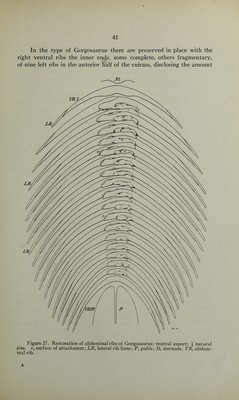
The Cretaceous theropodus dinosaur Gorgosaurus / by Lawrence M. Lambe.
- Lambe, Lawrence M. (Lawrence Morris), 1863-1919.
- Date:
- 1917
Licence: In copyright
Credit: The Cretaceous theropodus dinosaur Gorgosaurus / by Lawrence M. Lambe. Source: Wellcome Collection.
64/112 page 44
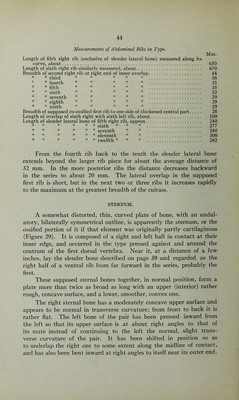
![Measurements of Abdominal Ribs in Type. Mm. Length of fifth right rib (exclusive of slender lateral bone) measured along its curve, about. 650 Length of sixth right rib similarly measured, about. 670 Breadth of second right rib at right end of inner overlap. 44 “ “ third “ “ “ “ “ . 36 “ fourth “ “ “ “ “ . 35 “ “ fifth “ “ “ “ “ 35 “ “ ojxth “ “ “ “ “ 32 “ “ seventh “ “ “ “ “ !!!!!!!!!!!!!”!!!! 29 “ “ eighth “ “ “ “ “ 29 “ “ ninth “ “ “ “ “ 29 Breadth of supposed co-ossified first rib to one side of thickened central part. 28 Length of overlap of sixth right with sixth left rib, about. 100 Length of slender lateral bone of fifth right rib, approx. 240 u a u « « « gjxth « « “ 277 “ “ “ “ “ “ seventh “ “ !!!!!!!!!!!!]!!!!! 1!!! 280 “ “ “ “ “ “ eleventh “ “ . 300 “ “ “ “ “ “ twelfth “ “ “ . . . ,. 282 From the fourth rib back to the tenth the slender lateral bone extends beyond the larger rib piece for about the average distance of 32 mm. In the more posterior ribs the distance decreases backward in the series to about 20 mm. The lateral overlap in the supposed first rib is short, but in the next two or three ribs it increases rapidly to the maximum at the greatest breadth of the cuirass. STERNUM. A somewhat distorted, thin, curved plate of bone, with an undul- atory, bilaterally symmetrical outline, is apparently the sternum, or the ossified portion of it if that element was originally partly cartilaginous (Figure 29). It is composed of a right and left half in contact at their inner edge, and occurred in the type pressed against and around the centrum of the first dorsal vertebra. Near it, at a distance of a few inches, lay the slender bone described on page 39 and regarded as the right half of a ventral rib from far forward in the series, probably the first. These supposed sternal bones together, in normal position, form a plate more than twice as broad as long with an upper (interior) rather rough, concave surface, and a lower, smoother, convex one. The right sternal bone has a moderately concave upper surface and appears to be normal in transverse curvature; from front to back it is rather flat. The left bone of the pair has been pressed inward from the left so that its upper surface is at about right angles to that of its mate instead of continuing to the left the normal, slight trans¬ verse curvature of the pair. It has been shifted in position so as to underlap the right one to some extent along the midline of contact, and has also been bent inward at right angles to itself near its outer end.](https://iiif.wellcomecollection.org/image/b29809940_0064.jp2/full/800%2C/0/default.jpg)