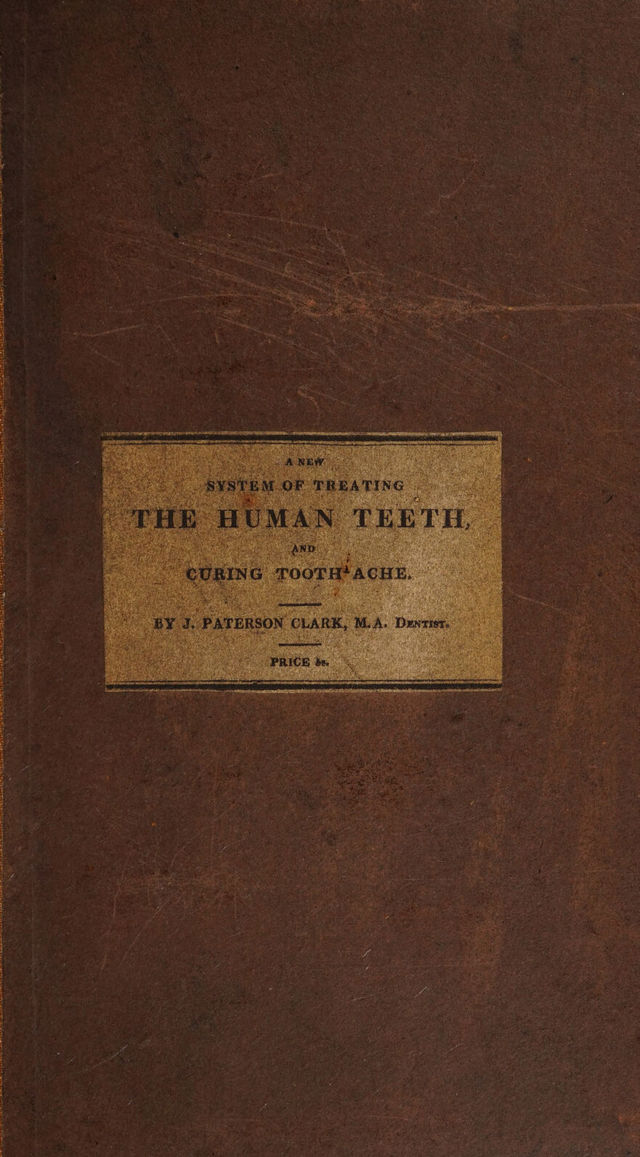
A new system of treating the human teeth; explaining the causes which lead to their decay, and the most approved methods of preserving them. With copious and explanatory notes : to which is added some account of a discovery made by the author for the cure of tooth-ache, and tic douloureux. &c. &c / By J. Paterson Clark.
- Clark, J. Paterson (John Paterson)
- Date:
- 1829
Licence: Public Domain Mark
Credit: A new system of treating the human teeth; explaining the causes which lead to their decay, and the most approved methods of preserving them. With copious and explanatory notes : to which is added some account of a discovery made by the author for the cure of tooth-ache, and tic douloureux. &c. &c / By J. Paterson Clark. Source: Wellcome Collection.
22/180 page 10
![teeth, lateral pressure against each other, and accidental causes of decay. animals are also furnished with long pointed, and strong cuspidati or canine teeth, which are employed as weapons of offence and defence, and are very serviceable in seizing and lacerating their prey ; they constitute in some animals, as the lion, tiger, &c- very formida- ble weapons. The herbivorous animals are not armed with these terrible canine teeth; their molares have broad flat surfaces, opposed in a vertical line to each other in the two jaws. Plates of enamel are intermixed with the bone of the tooth in the latter, and as its superior hardness makes it wear less rapidly than the other textures of the teeth, it appears on the grinding surface in rising ridges, which must greatly increase the triturating effect. In carnivorous animals the enamel is confined altogether to the surface of the teeth. The articulation of the lower jaw differs in the two cases as much as the structure of the teeth, In the carnivora it can only move backwards and forwards, all lateral motion being produced by the rising edges of the glenoid cavities: in the herbivora it has, more- over, motion from side to side. Thus we observe in the flesh-eaters, teeth calculated only for tearing, subservient, in parts at least, to the procuring of food, as well as to purposes of defence; and an articulation of the lower jaw, that precludes all lateral motion. In those which live on vegetables, the form of the teeth and the nature of the joint, are calculated for the lateral or grinding motion, The former, having rudely torn and divided the food, swallow it in masses ; while in the latter, it undergoes considerable comminution before it is swallowed. The teeth of man have not the slightest resemblance to those of the carnivorous animals, except that their enamel] is confined to the external surface; he possesses, indeed, teeth called canine, but they do not exceed the level of the others, and are obviously unsuited to the purposes which the corresponding teeth execute in carnivorous animals. The obtuse tubercles of the human molares have not the most remote resemblance to the pointed projections of these teeth in carnivorous animals; they areas clearly distinguished from the flat crowns, with intermixed enamel, of the herbivorous molares. In the freedom of lateral motion, however, the human inferior maxilla more nearly resembles that of the herbivora.](https://iiif.wellcomecollection.org/image/b33284490_0022.jp2/full/800%2C/0/default.jpg)