The Horace Dobell lectures on insect porters of bacterial infection : delivered before the Royal College of Physicians Lecture II: The transmission of plague by fleas / by C.J. Martin.
- Martin, Charles J. (Charles James), Sir, 1866-1955.
- Date:
- [date of publication not identified]
Licence: Public Domain Mark
Credit: The Horace Dobell lectures on insect porters of bacterial infection : delivered before the Royal College of Physicians Lecture II: The transmission of plague by fleas / by C.J. Martin. Source: Wellcome Collection.
3/22 page 59
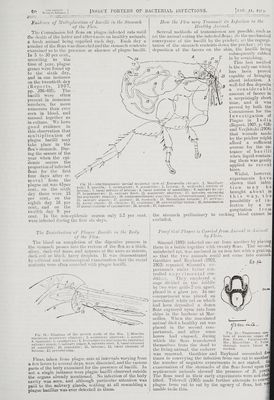
![Three years before Napoleon's death we may reasonably suppose that the inflamination of the liver which’ fre- quently appears in cases of fever cndemic to. tropical countries had brought about adhesions to the diaphragm and stomach. Hence it was impossible to feel any tumour ju a stomach thus bound down bencath the liver. Skilled physicians like Herean (1829) and Boudounin (1901) ?° have supposed the great ulcer found in the stomach at death to have been caused not by cancer, but by inflammation, _ I do not think that their opmion can be upheld; it is altogetlicr in opposition to the appearances and characters described by Antommarchi—the only account worthy of a moment's thought. Nor do I think that the view adopted py Dr. Chaphn—that the carlicr symptoms were solely dae to an uleer of the stomach—can be accepted as a full and satisfactory explanation. Py It is plain. then. that Napoleon suffered originally from an endemic fever in which the liver was severely affected, and that in the course of the illness cancer of the stomach his father’s ailment—supervened, but the symptoms of tle supcradded disease were entirely masked by the orivinal disease. When that interpretation is applied, Napoleon's case becomes clear, definite. and understand- able. It was a condition which might well have baffiea and misled the most skilful physicians in Europe, until the terminal illness in the spring of 1821, when Dr. Arnott! alleges he began to suspect that the stomach was the seat of Napoleon's trouble. The discovery of cancer at the autopsy was a revelation to all; the Emperor alone anticipated the result. Poor O'Meara, Stolkoc. and Antommarchi! Dismissed. court-inartialled, and maligned by the laymen in authority and by modern Jay writers because they did not solve a problem which only was capable of a full solution after death. In the main they were right in their diagnosis : most unfortunate in their treatment. It is an open question whether it was the fever or the cancer which actually killed Napoleon ; the best that can be said is that, whether in St. Helena or ont of it. cancer weuld have ended the career of the great Emperor. REFERENCES. Tord Rosebery, Napoleon, Lhe Last Phase, 1900. *Freaneaux, P., Tin Deana of St, Helena, London, 1910 (translation of Les Derniers Jors del Emperenr. Paris, 1999). § The Life of Sir Astien Coaper, Burt... Vransby B. Cooper. 1843. vol. ii, p. 108. 2 Antoinmarchi. F.. The dorsi Daas or Napoleon, 1825: see al-o renderings of Antommarcli’s report siven by J. Hereau (the inost accurate) and by M. Fréimeaux, i Napiicon a Satate Helene, by 1. Héreau, surgeon to Madame Meére and the Empress Marie Louise, 1829. 6Prodromo delia Grande dAuclomia, Seconda Opera Postunia di Paolo Mascagni: da Francesco Anternmarchl Dissettore Anatouico, Firenze. 1899 (dedicated to Geovsio Federigo Augusto. Prince Regent). * London Alediteal and Sera Jowriiel, 1835, vol. vii, p. 785 (two volumes nuinbered vii were piblished in 1835: the only copy in London is at the College of Puveioans:, “Lettre des Heritiers du feu Paw Mascagni a Monsiewr i Comic de Lastenri¢, a Paris, 1823. “ Barry E. O'Meara, Napolcon at “ft. Helens, edition of 1888. 1’ Marcel Boudouin. Gazetie Médicale de DPuere. 1991, Ixxii, p.81. MN Archibald Arnott, M.D., An Account of the d.t-! Liiness, Disease, and Post Mortem of Napoleon Bonaparte, 1622. . THE German Gynaecological Society will hold its Rftcenth annual meeting at Halle in May (14th-17th). Phe yrincipal subject proposcd for discussion is the relation between diseases of the heart and kidneys as wel as disturbances of internal secretion with pregnancy. AHE Departinent of Health of the city of New York has atthorized the performance by its inspectors of anti- typhoid vaccination under conditions similar to those eeverning the frec adiwinistration of diphtheria autitoxin. Eten Will also be supplied free to medical practi- lade their own use. vs Ors *ssuc of the journal entitled Concrete and eee Enginéering contains some striking state: re “Un vefercnce to the safety of vavions buildings in oe 6 a Pesan to fire. “Seven years ago a ver~lidage ne) * OF buildings had been officially recognized as not “SoH the requirements of the London County Council Teisits * iu ‘Gage E Sok : i havl to general construction. the provision of escapes. ait , ‘ : . . . her measures designed to diminish the annual Pumber of deaths from fire. 22 over 90, Which are of} tiga Mibahit be StWard in It is stated that there are 000 buildings within the metropolitan area icially ‘+ unsafe.’ Suggestions as tohow the remedied without undue delay are also put the journal in question. The other articles. iy technical. contain nevertheless a good deal at , : s ; aan. Of geucral interest. A subject worthy of dis- es at ID its pages would scem to be the truth or other- buildin @ popular impression to the effect that + fireproof” me . ‘, “ ‘ ae : cs a5 burn ny quite as quickly, or guite as efectualls Rhic oo Gestruction of life is concerned, as buildings Claim no such title. Suse tt gle t. THEPRITIN » © Mewicc, JOcRNAL * 59 Che Porace Dobell Lectures : s INSECT PORTERS OF BACTERTAL INFECTIONS. DELIVERED BEFORE THE RoysaL COLLEGE OF PHYSICIANS. By C.. MARTIN, My Bsc, FR, DIRECTOR OF THE LISTEN INSTIPCLE OF PREVENTIVE, MEDICINE, PROFESSOR OF ERPIERIMININGE PATHOLOGY IN THe UNIVERSITY OF LONDON, LECTURE it Tut TRANsMIssioN oF PLAGUE BY FLEAs. May I remind you that bubonic plague is not an infectious disease? ‘Tlie patient is a negligible source of danger to his surroundings, provided he does not devclop a secondary pneumonia. The reason is that, even if the excreta do contain some plague bacilli, there is no mechanism avail- able to convey them into a second human being, as pest 1s not easily contracted by feeding. I'rom an epidemioloyical of rats, in which, under suitable conditions, the infection spreads from rats to man. It would be impossible for me to put before you tlis afternoon the mass of evidence for the above statements. IT have already surveyed it in opening the discussion on the “Spread of Plague” at the meeting of the British Medical Association at Birmingham in 1911 (Martin, 1911), and, moreover, it 1s now Well known. It was difficult to explain how the bacillus was trans- ferred to inan fiom the rat, especially as man-to-man infection had been shown to be negligible. On epideniio- logical grounds, Ogata (1897), Simond (1898), and Ashburton Thompson (1900) came to the conclusion that the agent must be soine form of insect, aud for various reasons choice fell upon the flea. You will naturally inquire why. if the flea is to be con- sidered an agent of transmission from rat to man, does it not transmit from man to man? The answer is quite satisfactory. but I will, with your permission, postpone it until we have considered the case for carriage from rat to man. If the blood of the animal contain a sufficiency of plague bacilli, some will obviously be taken in by a flea whilst feeding, and Ogata (1897) found that crushed fleas taken from’a plague-infected rat produced the disease when injected into mice. This experiment was repeated with success by Simond (1898) and Tidswell] (1900). The Mechanism by Means of which the Flea might Infect a Healthy Animal. The blood is sucked up from the wound made by the pricker. This structure is composed of three parts—the epipharynx and the two mandibles (Fig. 14). The appo- sition of the three forms a fine tube (big. 15), up which the blood is drawn, and passed down the guilet into the stomach by successive waves of contraction from before backwards of the muscles actuating the chitinous pharynx. The stomach is a pear-shaped organ occupying a con- siderable part of the abdomen of the insect. The internal economy of a flea and the arrangements of the mouth parts may be gleaned from the diagrams (Figs. 13, 14, and 15), which are borrowed from the Reporis of the Comission. The average capacity of a rat-flea’s stomach was found by the Connnission for the Investigation of Plague in India (Report; 1907, p. 397) to be 0.5 tinm., andthe number of bacilli in the blood of a plague-intected rat before death anything up to 100,000,000 bacilli per cubic centimetre. If, therefore. a rat-flea imbibed the bloca of such a rat, it would receive into its stomach 5,000 germs. * In dealing with the agency of fleas in tbe spread of plague I shall draw Jargely upon the work accomplished during the last few years by the Commission fer the Investigation of Plague in India, with which IT have lad the honour to he associated. The Reports of the Comunission have been published as special numbers of the Journal of Hugienc, 1906 to 1912.](https://iiif.wellcomecollection.org/image/b33453044_0003.jp2/full/800%2C/0/default.jpg)