A practical treatise on genito-urinary and venereal diseases and syphilis / by Robert W. Taylor.
- Taylor, Robert W. (Robert William), 1842-1908
- Date:
- 1901
Licence: In copyright
Credit: A practical treatise on genito-urinary and venereal diseases and syphilis / by Robert W. Taylor. Source: Wellcome Collection.
22/806 (page 20)
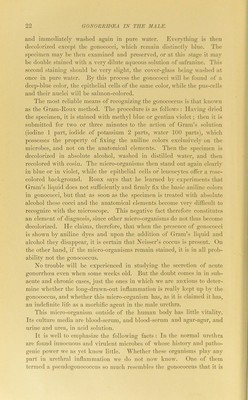
![line. In these particulars the gonococcus resembles other diplococci. In its multiplication this cliplococcus divides by a transverse cleavage or at right angles to the median fissure. By tliis means of fission each pair of the diplococcus is converted into four diplococci, which are grouped in fours. The mode of division is .schematically pictured in Fig. 1. Beginning at the left hand of the figure, the line of cleavage is shown to be more and more distinct until the full develoj)- ment is reached, as pictured in the right-hand figure. In this way these micro-organisms increase and raultijjly. Other diplococci, how- ever, develop in a similar manner. From this method of transverse fission and growth originates the peculiar grouping of the gonococcus into twos and fours and their multiple derivatives. In the acute stage of gonorrheea these diplococci are found in greater or less number encapsulated in masses within the pus-cell. When numerous and thus seated they have been said to present the appear- ance of a swarm of bees. Under rather low powers they look like little particles of gunpowder. They may be so numerous within a pus-cell as to rupture its wall. Then we find the cocci lying free in the serum, scattered in a disordered manner between the pus-cells, but even then presenting the four and multiple-of-four arrangement. Early in the infection gonococci are seen seated upon epithelial cells. Under microscopical examination gonococci are readily found and recognized in the pus of acute gonorrheea. Then the clinical features of the infection and the microscopical picture of the discharge and its pus, epithelium, if present, and di])lococci, taken together, are so strik- ing and unvarying that a mistake can scarcely occur. But in later stages of true gonorrhoea, and in many more or less subacute cases of urethral suppuration, it is very often most difficult, and sometimes impos.sible, to say whether the microbe is the gonococcus or some other form of diplococcus. In all cases the crucial test rests in cultivations and inoculations. While, however, there is no single individual sign or mode of dis- tinction of the gonococcus, there are a number of signs which, when taken together, offer strong ])resuni])tive evidence that the microbe in question is the one just named. Tliese are— 1. The shape, which is, as we have seen, roundly oval, with its median fissure and its roll-like or coffee-bean appearance, and its lengtli- wise fissure. 2. The size : they are large diplococci, and in their development are variable and resemble other diplococci. 3. The grouping, as a result of their mode of division, is in single pairs, in fours, eiglits, .sixteens, etc. They never occur in chains. 4. Tlieir intracellular position : the gonococci are found in heaps](https://iiif.wellcomecollection.org/image/b28079413_0022.jp2/full/800%2C/0/default.jpg)