A practical treatise on genito-urinary and venereal diseases and syphilis / by Robert W. Taylor.
- Taylor, Robert W. (Robert William), 1842-1908
- Date:
- 1901
Licence: In copyright
Credit: A practical treatise on genito-urinary and venereal diseases and syphilis / by Robert W. Taylor. Source: Wellcome Collection.
24/806 (page 22)
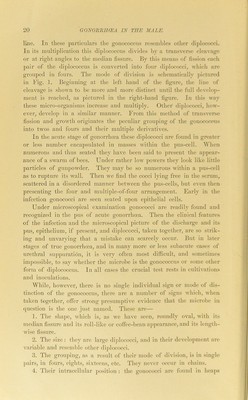
![and immediately washed again in pure water. Everything is then decolorized except the gonococci, which remain distinctly blue. The specimen may be then examined and preserved, or at this stage it may be double stained with a very dilute aqueous solution of safranine. This second staining should be very slight, the cover-glass being washed at once in pure water. By this process the gonococci will be found of a deep-blue color, the epithelial cells of the same color, while the pu.s-cells and their nuclei will be salmon-colored. The most reliable means of recognizing the gonococcus is that known as the Gram-Roux method. The procedure is as follows : Having dried the specimen, it is stained with methyl blue or gentian violet; then it is submitted for two or three minutes to the action of Gram’s solution (iodine 1 part, iodide of potassium 2 parts, water 100 parts), which possesses the property of fixing the aniline colors exclusively on the microbes, and not on the anatomical elements. Then the specimen is decolorized in absolute alcohol, washed in distilled water, and then recolored with eosiu. The micro-organisms then stand out again clearly in blue or in violet, while the epithelial cells or leucocytes offer a rose- colored background. Roux says that he learned by experiments that Gram’s liquid does not sufficiently and firmly fix the basic aniline colors in gonococci, but that as soon as the sjtecimen is treated with absolute alcohol these cocci and the anatomical elements become very difficult to recognize with the microscope. This negative fact therefore constitutes an element of diagnosis, since other micro-organisms do not thus become decolorized. He claims, therefore, that when the pre.sence of gonococci is shown by aniline dyes and upon the addition of Gram’s liquid and alcohol they disappear, it is certain that !Neisser’s coccus is present. On the other hand, if the micro-organisms remain stained, it is in all prob- ability not the gonococcus. No trouble will be experienced in studying the seci*etion of acute gonorrhoea even when some weeks old. But the doubt comes in in sub- acute and chronic cases, just the ones in which we arc anxious to deter- mine whether the long-drawn-out inflammation is really kept up by the gonococcus, and whether this micro-organism has, as it is claimed it has, an indefinite life as a morbific asrent in the male lu'cthra. This micro-organism outside of the human body has little vitality. Its culture media are blood-scrum, and blood-scrum and agar-agar, and urine and urea, in acid solution. It is well to emphasize the following facts : In the normal urethra arc found innocuous and virulent microbes of whose history and patho- genic power we as yet know little. Whether those organisms jilav any ])art in urethral inflammatiou we do not now know. One of them termed a pscudogonococcus so much resembles the gonococcus that it is](https://iiif.wellcomecollection.org/image/b28079413_0024.jp2/full/800%2C/0/default.jpg)