Volume 1
Typographical antiquities; or the history of printing in England, Scotland, and Ireland: containing memoirs of our ancient printers, and a register of the books printed by them / Begun by the late Joseph Ames, F.R. & A.SS. Considerably augmented by William Herbert, of Cheshunt, Herts; And now greatly enlarged, with copious notes, and illustrated with appropriate engravings; comprehending the history of English literature, and view of the progress of the art of engraving, in Great Britain; by the Rev. Thomas Frognall Dibdin.
- Joseph Ames
- Date:
- 1810
Licence: Public Domain Mark
Credit: Typographical antiquities; or the history of printing in England, Scotland, and Ireland: containing memoirs of our ancient printers, and a register of the books printed by them / Begun by the late Joseph Ames, F.R. & A.SS. Considerably augmented by William Herbert, of Cheshunt, Herts; And now greatly enlarged, with copious notes, and illustrated with appropriate engravings; comprehending the history of English literature, and view of the progress of the art of engraving, in Great Britain; by the Rev. Thomas Frognall Dibdin. Source: Wellcome Collection.
Provider: This material has been provided by Royal College of Physicians, London. The original may be consulted at Royal College of Physicians, London.
30/672 (page 6)
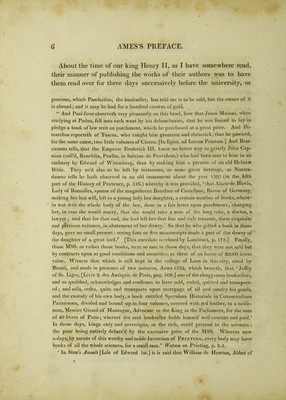
![About the time of our king Henry II, as I have somewhere read, their manner of publishing the works of their authors was to have them read over for three days successively before the university, or precious, which Paschasius, the bookseller, has told me is to be sold, but the owner ol it is abroad ; and it may be had for a hundred crowns of gold. “ And Paul Jove observeth very pleasantly on this head, how that Jason Mainus, when studying at Padua, fell into such want by his debaucheries, that he was forced to lay in pledge a book of law writ on parchment, which he purchased at a great price. And Pe- trarchus reporteth of Tuscus, who taught him grammar and rhetorick, that he pawned, for the same cause, two little volumes of Cicero. [In Epist. ad Lucam Pennant.] And Bras- sicanus tells, that the Emperor Frederick III. knew no better way to gratify John Cap- nion (call’d, Reuchlin, Praefat. in Salvian. de Provident.) who had been sent to him in an embassy by Edward of Witemberg, than by making hint a present of an old Hebrew Bible. They us’d also to be left by testament, as some great heritage, as Nostra- damus tells he hath observed in an old instrument about the year 1393 (in the fifth part of the History of Provence, p. 516.) whereby it was provided, ‘ that Alaziede Blevis, Lady of Romolles, spouse of the magnificent Boniface of Castellane, Baron of Germany, making her last will, left to a young lady her daughter, a certain number of books, where- ~ in was writ the wdiole body of the law, done in a fair letter upon parchment; charging her, in case she would marry, that she would take a man of the long robe, a doctor, a lawyer ; and that for that end, she had left her that fine and rich treasure, these exquisite and precious volumes, in abatement of her dowry.’ So that he who gifted a book in those days, gave no small present: seeing four or five manuscripts made a part of the dowry of the daughter of a great lord.” [This anecdote is related by Lambinet, p. 173.] Finally, those MSS. or rather those books, were so rare in those days, that they were not sold but by contracts upon as good conditions and securities, as these of an house of 20000 livres value. Witness that which is still kept in the college of Laon in this city, cited bv Brenil, and made in presence of two notaries, Anno 1332, which beareth, that ‘ Jeffrv of St. Liger, [Livre 2. des Antiquit, dc Paris, pag. b'08.] one of the clergy-men booksellers, and so qualified, acknowledges and confesses to have sold, ceded, quitted and transport- ed ; and sells, cedes, quits and transports upon mortgage of all and sundry his goods, and the custody of his own body, a book entitled Speculum Historiale in Consuetudines Parisienses, divided and bound up in four volumes, covered with red leather, to a noble- man, Messire Girard of Montague, Advocate to the King in the Parliament, for the sum of 40 livres of Paris; whereof the said bookseller holds himself well content and paid.’ In those days, kings only and sovereigns, or the rich, could pretend to the sciences : the poor being entirely debarr’d by the excessive price of the MSS. Whereas now a-days, by means of this worthy and noble Invention of Printing, every body may have books of all the whole sciences, for a small sum.” Watson on Printing, p. 2-5. ‘ In Stozv’s Annals [Life of Edward 1st.] it is said that William de Howton, Abbot of](https://iiif.wellcomecollection.org/image/b28267461_0001_0030.jp2/full/800%2C/0/default.jpg)