Volume 1
Typographical antiquities; or the history of printing in England, Scotland, and Ireland: containing memoirs of our ancient printers, and a register of the books printed by them / Begun by the late Joseph Ames, F.R. & A.SS. Considerably augmented by William Herbert, of Cheshunt, Herts; And now greatly enlarged, with copious notes, and illustrated with appropriate engravings; comprehending the history of English literature, and view of the progress of the art of engraving, in Great Britain; by the Rev. Thomas Frognall Dibdin.
- Joseph Ames
- Date:
- 1810
Licence: Public Domain Mark
Credit: Typographical antiquities; or the history of printing in England, Scotland, and Ireland: containing memoirs of our ancient printers, and a register of the books printed by them / Begun by the late Joseph Ames, F.R. & A.SS. Considerably augmented by William Herbert, of Cheshunt, Herts; And now greatly enlarged, with copious notes, and illustrated with appropriate engravings; comprehending the history of English literature, and view of the progress of the art of engraving, in Great Britain; by the Rev. Thomas Frognall Dibdin. Source: Wellcome Collection.
Provider: This material has been provided by Royal College of Physicians, London. The original may be consulted at Royal College of Physicians, London.
32/672 page 8
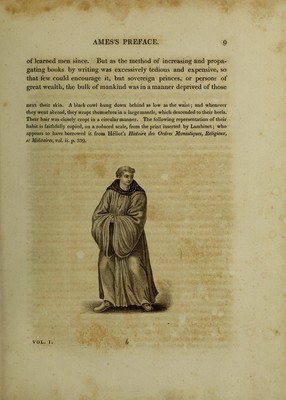
![At the time that Printing was introduced, and a little after, the scribes used their utmost efforts to excel, being willing to keep their places, and would say such a book was old, and would add unpro- fitable ; but such an one was new, neat, elegantly wrote, easy to be read, &c. which method of proceeding, by the way, may have occa- sioned the loss of many a good composition. Indeed before this noble art of Printing by separate types made of metal was found out, there were but few authors in comparison to the great encrease able revenues were appropriated. A noble Norman, who was a great encourager of learning, left his own library to that of the Abbey of St. Albans, A.D. 1086, and granted two thirds of the tithes of Hatfield, and certain tithes in Redburn, to support the Scribes in the Scriptorium of that abbey. Where there were no fixed revenues for defraying the expenses of procuring books for the library, the abbot, with the consent of the chapter, commonly imposed an annual tax on every member of the community for that purpose. The monks of some monasteries in this period were bitterly reproached for the extrava- gant sums they expended on their libraries. [Vide M. Paris Vila Abbatum, p. 32: Mabill. Annal. vol. iv. 651-2: Martin Col. Sciipt. vol. i. 1020-21 : as referred to by Dr. Henry.] The monastic writers, or copiers of manuscripts, have been thought by some to be the last relics of the Jewish Scribes, or the Roman Librarii. Mr. Astle, in the 8th chapter of his ‘ Origin and Progress of Writingand Strutt, in his ‘ Regal and Ecclesiastical Anti- quities,' have slightly noticed them ; but from Lambinet we obtain the following curious account of their history in the middle centuries : “Gerard de Groot, or Gerard the Great, instituted a society called ‘ Fratres Vita Communis.' This extraordinary character was born at Deventer, in the year 1340. His parents took the greatest possible care of his education ; and at 15 years of age he was sent to Paris to perfect himself in philosophical and theological studies. His general knowledge afterwards procured for him the distinctive appellation of The Great: but, in the midst of his intellectual celebrity, he was not free from the justly founded stigma of leading a debauched and luxurious life. An accidental but serious conversation with one of his old schoolfellows suddenly converted him. He now became as grave, devout, and exemplary, as he had been formerly licentious and relaxed. He clothed himself in a doublet of grey, lined with hair, and retired to a monastery at Munikhuysen, where he devoted himself to prayer, and to the reformation of immoral characters. Meeting with unexpected success in this pious avocation, he instituted the society before mentioned ; and could boast, among his followers, of such characters as Rudewyns and Thomas a Kempis. 1 One heart, one soul, one common property,’ says Lambinet, * influenced and supported this illustrious society; whose glory it was that they earned their livelihood by their pen.’ They were always distinguished by wearing a grey coat, lined with hair,](https://iiif.wellcomecollection.org/image/b28267461_0001_0032.jp2/full/800%2C/0/default.jpg)
 No text description is available for this image
 No text description is available for this image
 No text description is available for this image