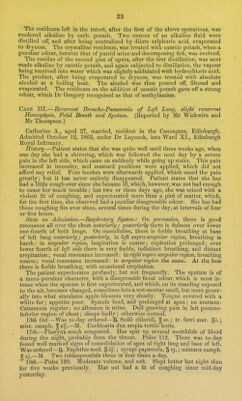
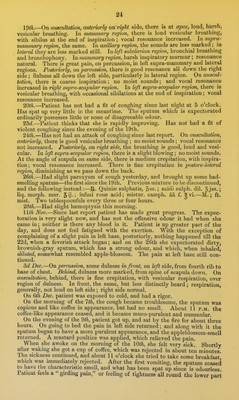
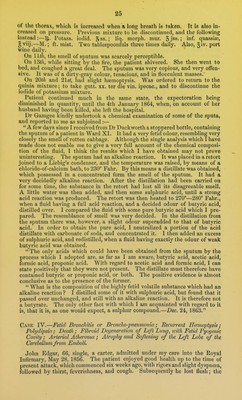
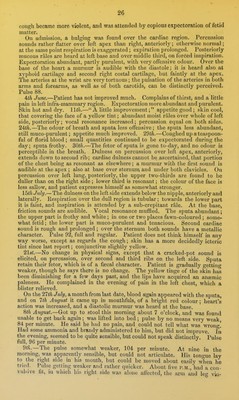
Notes on fetid bronchitis and other lung-diseases with fetid breath / by Thomas Laycock.
- Thomas Laycock
- Date:
- 1865
Licence: Public Domain Mark
Credit: Notes on fetid bronchitis and other lung-diseases with fetid breath / by Thomas Laycock. Source: Wellcome Collection.
Provider: This material has been provided by The University of Glasgow Library. The original may be consulted at The University of Glasgow Library.
27/32 page 25
![of the thorax, which is increased when ft long breath is taken. It is also in- creased on pressure. Previous mixture to be discontinued, and the following instead:—]J. Potass, iodid. 5ss.; Hq. morph. mur. 5jss.; inf. quassias, gviij.—M.; ft. mist. Two tablespoonfiUs three times daily. Also, ^iv. port wine daily. On 11th, the smell of sputum was scarcely perceptible. On IBth, while sitting by the tire, the patient shivered. She then went to bed, and coughed a great deal. The sputum was very copious, and very offen- sive. It was of a dirty-gray colour, tenacious, and in flocculent masses.' On 20th and 21st, had slight haemoptysis. Was ordered to return to the quinia mixture; to take gutt. xx. ter die vin. ipecac, and to discontmue the iodide of potassium mixture. Patient continued much in the same state, the expectoration being diminished in quantity, until the 4th January 1864, when, on account of her husband having been killed, she left the hospital. Dr Gamgee kindly undertook a chemical examination of some of the sputa, and reported to me as subjoined :— A few days since I received from Dr Duckworth a stoppered bottle, containing the sputum of a patient in Ward XI. It had a very fetid odour, resembling very closely the smell of rotten cabbage. Although the single analysis which T have made does not enable me to give a very full account of the chemical composi- tion of the fluid, I think the results which I have obtained may not prove uninteresting. The sputum had an alkaline reaction. It was placed in a retort joined to a Liebig's condenser, and the temperature was raised, by means of a chloride-of-calcium bath, to 230° Fahr. By this means a distillate was obtained, which possessed in a concentrated form the smell of the sputum. It had a very decidedly alkaline reaction. After the distillation had been carried on for some time, the substance in the retort had lost all its disagreeable smell. A little water was then added, and then some sulphuric acid, until a strong acid reaction was produced. The retort was then heated to 270°—280° Fahr., when a fluid having a full acid reaction, and a decided odour of butyric acid, distilled over. I compared the fluid with some pure butyric acid which I pre- pared. The resemblance of smell was very decided. In the distillation from the sputum there was, however, a slight odour superadded to that of butyric acid. In order to obtain the pure acid, I neutralized a portion of the acid distillate with carbonate of soda, and concentrated it. I then added an excess of sulphuric acid, and redistilled, when a fluid having exactly the odour of weak butyric acid was obtained. The only acids which could have been obtained from the sputum by the process which I adopted are, as far as I am aware, butyric acid, acetic acid, formic acid, proponic acid. With regard to acetic acid and formic acid, I can state positively that they were not present. The distillate must therefore have contained butyric or proponic acid, or both. The positive evidence is almost conclusive as to the presence of the former. What is the composition of the highly fetid volatile substance which had an alkaline reaction? I distilled some of it with sulphuric acid, but found that it passed over unchanged, and still with an alkaline reaction. It is therefore not a butyrate. The only other fact with which I am acquainted with regard to it is, that it is, as one would expect, a sulphur compound.—Dec. 24, 1863. Case IV.—Fetid BroncMtts or Broncho-prmmonia; Recurrent Hccmoptysis; Polydipsia; Death ; Fibroid Degeneration of Left Lung, ivith Fetid Pyogenic Cavity ; Arterial Atheroma ; Atrophy and Softening of tlie Left Lobe of the Cerebellum from Emboli. John Edgar, 66, single, a carter, admitted under my care into the Royal Infirmary, May 28, 1856. The patient enjoyed good health up to the time of present attack, which commenced six weeks ago, with rigors and slight dyspnoea, followed by thirst, fevcrishness, and cough. Subsequently he lost flesh; the](https://iiif.wellcomecollection.org/image/b21481246_0027.jp2/full/800%2C/0/default.jpg)