Synopsis of lectures on diseases of the skin / by Robert John Garden.
- Garden, Robert John.
- Date:
- 1889
Licence: Public Domain Mark
Credit: Synopsis of lectures on diseases of the skin / by Robert John Garden. Source: Wellcome Collection.
45/104 page 37
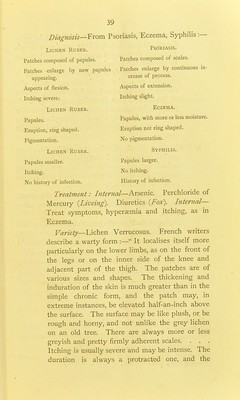
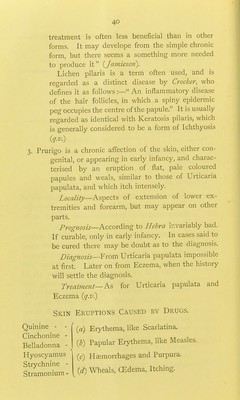
![[Sheet 4.] Pityriasis rosea of Gibert {Syn : Pityriasis Rubra maculata, Bazin) begins on the neck and thorax as small non-elevated maculae,with pollard-looking scales. In the course of a few days it spreads circumferentially, the central part becoming of a yellow colour, while the peripheral redness merges gradually into the normal colour of the skin. The disease may spread over the whole surface of the body, but rarely attacks the face. It is accompanied by fever, lasts from four to six weeks and spontaneously disappears. Treatment—Placebo. Boracic Ointment (S. Mackenzie). VII. Papular Dermatoses. To these the name Lichen is given. Willan described a number of forms :—Lichen Strophulus or Red Gum, Lichen Strophulus Volaticus or Wild Fire, Lichen Agrius, v. Tropicus or Prickly Heat, which are varieties of Eczema (g.v.) and Lichen Urticatus, which belongs to Urticaria (q.v.) The term is now restricted to— i. Lichen Scrofulosorum, an eruption of small vari- ously grouped papules of the colour of the skin, or of a yellowish brown or red colour. It is usually confined to the trunk, but may appear on the extremities and face. Each papule cor- responds to a hair, and is due to hypertrophy of the walls of the hair sac, with accumulation of morbid products in the follicle. When rubbed with the hand the skin feels dry and rough. There is little or no itching. The disease is chronic, and occurs in scrofulous subjects, chiefly in children. Treatment—Cod Liver Oil.](https://iiif.wellcomecollection.org/image/b20385778_0045.jp2/full/800%2C/0/default.jpg)