Physiology : A manual for students and practioners / by Theodore C. Guenther and Augustus E. Guenther.
- Guenther, Theodore C. (Theodore Charles)
- Date:
- 1903
Licence: Public Domain Mark
Credit: Physiology : A manual for students and practioners / by Theodore C. Guenther and Augustus E. Guenther. Source: Wellcome Collection.
Provider: This material has been provided by the Augustus C. Long Health Sciences Library at Columbia University and Columbia University Libraries/Information Services, through the Medical Heritage Library. The original may be consulted at the the Augustus C. Long Health Sciences Library at Columbia University and Columbia University.
189/260 (page 187)
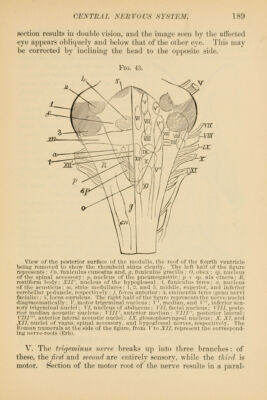
![l)ody, both of sensation and of motion, of a degree depending npon tiie extent of the lesions ; and, besides, result in a paralysis of the motor oeuli nerve of the same side aa the lesions. There is a derangement of the ooilnlination of movements, sliown in rotary movements when the suhjeet attempts to walk. It is inferred that co'irdinating im|)ulses pass througli the crura. The a)ik'rior cor/ioni (ji((alri(iriiiiii<i are the homologues of the optic lobes in some of the lower animals, and the anterior pair may be regarded as important centres for the rixiKtl and motor fanctionn of the ei/es. The posterior pair are associated more intimately with the sense of hearing. Not only does blindness follow lesions of the anterior pair, but often they are atrophied when the eyes are destroyed. Crossed paralysis may follow lesions in the lower portion of the pons, which is more or less complete, together with a paralysis of the facial muscles on the same side as the lesions. As the mednUa is the sole connecting link between the upper part of the brain and the cord, it necessarily contains all fibres passing between these limits, so that it conducts all impulses. It resembles the spinal cord in being the seat of reflex acts ; the only difference between them being in the fact that many of the reflexes performed by the bulb are cf much greater importance to life. There is a considerable number of centres in the medulla which control important and comidicated coiirdinated muscular actions. These are centres for reflex action for the most part, which are called upon to act in response to stimuli derived from an afferent impulse or to a voluntary effort. As examples, may be mentioned : the cardiac centre, the vasomotor centre, the thermotactic centre, and the respirator]! centre. The latter may be easily demonstrated in the frog. If the spinal cord be removed up to the meilulla, the respirations will continue, and in the same way they will not cease if the hemispheres also are removed. If the medulla is then injured at the origin of the pneumogastric nerve, the move- ments of respiration cease. The same occurs when the medulla is broken in man near the axis in executions by hanging. Divixion of the spinal cord results in a complete loss of conduc- tivity between the two segments. There are a loss of sensation and a paralysis of the parts supjilied by nerves emerging from the cord iielow the section. I^oth spirments of the cord may suffice for cer- tain reflex movements. If the sn-tion be maile al)ove the point of](https://iiif.wellcomecollection.org/image/b21220414_0189.jp2/full/800%2C/0/default.jpg)