Physiology : A manual for students and practioners / by Theodore C. Guenther and Augustus E. Guenther.
- Guenther, Theodore C. (Theodore Charles)
- Date:
- 1903
Licence: Public Domain Mark
Credit: Physiology : A manual for students and practioners / by Theodore C. Guenther and Augustus E. Guenther. Source: Wellcome Collection.
Provider: This material has been provided by the Augustus C. Long Health Sciences Library at Columbia University and Columbia University Libraries/Information Services, through the Medical Heritage Library. The original may be consulted at the the Augustus C. Long Health Sciences Library at Columbia University and Columbia University.
191/260 (page 189)
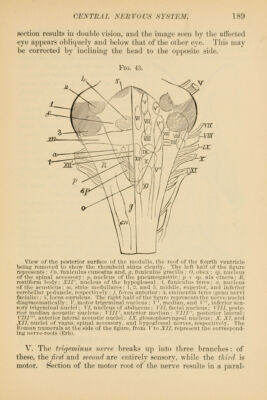
![section results in douhk' vision, and the image seen hv the afrt-ftecl eye ai)pears oMicjiicly and Ik-Iuw that of the othiT eye. This may be corrected hy inclining the head to the opposite side. Fig. 43. View of the posterior surface of the imdullii, the ronf of the fourth ventricle beinp removed to show the rhomboid sinus dourly. The left half of the figure represents : Cn. funiculus cuneatus and, q, funiculus gracilis : O, obex : ■••■}}. nucleus of the spinal accessory; p, nucleus of the pneuniogastric; p + 8p. ala cincra; R, restiform bf>dy; XII', nucleus of the hypoglossal: ^ funiculus teres: a, nucleus of the acusticus; m, stria- mcdullares: i,-, and 3. middle, su]>eri()r, and inferior cerebellar peduncle, respectively : /, fovea anterior: J, eniinentia teres igenu nervi facialis): n, locus cooruleus. The right half of the figure represents the nerve-nuclei diagranimatieally: I', motor trigeminal nucleus: I', median, and l, inferior sen- sory trigemiiuil nuclei: 17, n\iclc\is of abduccMis: 177, facial nucleus: 1777, poste- rior median acoustic nucleus: 1777'. anterior meiiian ; 17/7, posterior lateral; VIII', anterior lateral acoustic nuclei: 7A', glossopharyngeal nucleus: A', A7, and A'/7, nuclei of vagus, spinal accessory, and liypoglossal nerves, respectively. The Roman numerals at the side of the figure, from I'to A7/, represent the correspond- ing nerve-roots (Erb). V. The tn'rfeyninus )ierve breaks up into three branches: of these, the first and seconrl are entirely sensory, while the third is motor. Section of the motor root of the nerve results in a paral-](https://iiif.wellcomecollection.org/image/b21220414_0191.jp2/full/800%2C/0/default.jpg)