Physiology : A manual for students and practioners / by Theodore C. Guenther and Augustus E. Guenther.
- Guenther, Theodore C. (Theodore Charles)
- Date:
- 1903
Licence: Public Domain Mark
Credit: Physiology : A manual for students and practioners / by Theodore C. Guenther and Augustus E. Guenther. Source: Wellcome Collection.
Provider: This material has been provided by the Augustus C. Long Health Sciences Library at Columbia University and Columbia University Libraries/Information Services, through the Medical Heritage Library. The original may be consulted at the the Augustus C. Long Health Sciences Library at Columbia University and Columbia University.
51/260 (page 49)
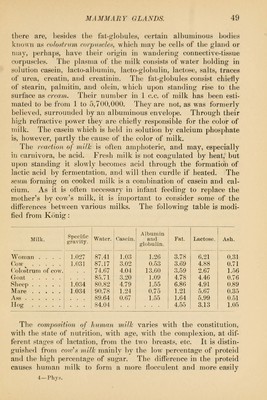
![.U.I.V,)M/M' GLANDS. 40 I here are, l)e>»i(k'.s ilw fat-jriohules, (certain alljimiiiious Ijudii-s known as m/ostrnm n>ipi()ic/cf<, \vlii(rli may 1r' cells ol tin; gland or tiKiy, perhaps, have their origin in wandering connective-tissue corpuscles. The plasma of the milk consists of water holding in solution casein, lucto-ulhumin, lacto-glohulin, lacto.><e, salts, traces of urea, creatin, and creatinin. The i'at-glohules consist chiefly of stearin, palmilin, and olcin, which upon standing rise to the surface as rrcain. Their nund)er in 1 c.c. of milk has been esti- mated to he from 1 to .>,7*><>,()()(). They are not, as was formerly i)elieve<l, surrounded by an albuminous envelope. Through their high refractive power they are chiefly responsible for the color of milk. The casein which is held in solution by calcium phosphate is, however, partly the cause of the color of milk. The rcaciloii of mi/k is often amphoteric, and may, especially ill carnivora, be acid. Fresh milk is not coagulated by heat, but upon standing it slowly becomes acid through the formation of lactic acid by fermentation, and will then curdle if heated. The sctan forming on cooked milk is a combination of casein and cal- cium. As it is often necessary in infant feeding to replace the mother's by cow's milk, it is im])ortant to consider some of the differences between various milks. The following table is modi- fied from Konig: Milk. ^?o.^hi^ Water. Casein, gravity Woman .... I 1.027 Cow ^ 1.031 ( (ildstruni (if cow. . . (Joiit Sheep 1.034 Mure i 1.034 Ass 1 . . . 87.41 87.17 74.07 85.71 80.82 90.78 89.64 1I( 84.04 1.03 3.02 4.04 3.20 4.79 1.24 0.67 Albumin 1 and Fat. Lactose. globulin. 1.26 3.78 6.21 0.53 3.69 4.88 13.60 3.59 2.67 1.09 4.78 4.46 1.55 6.86 4.91 0.75 1.21 5.67 1.55 1.64 5.99 4.55 3.13 1 Ash. 0.31 0.71 l.o6 0.76 U.89 0.35 0.51 1.05 The rnnipm^lf.lov of human milk varies with the constitution, with the state of nutrition, with age, with the complexion, at dif- ferent stages of lactation, from the two breasts, etc. It is distin- guished from coir'n milk mainly by the low percentage of proteid and the high percentage of sugar. The difierence in the proteid causes human milk to form a more llocculent and more easily l-l'i.v.-.](https://iiif.wellcomecollection.org/image/b21220414_0051.jp2/full/800%2C/0/default.jpg)