The Dublin dissector or manual of anatomy. Comprising a concise description of the bones, muscles, vessels, nerves and viscera, also the relative anatomy of the different regions of the human body, for the use of students in the dissecting room / By a member of the Royal College of Surgeons in Ireland [i.e. R. Harrison].
- Robert Harrison
- Date:
- 1835
Licence: Public Domain Mark
Credit: The Dublin dissector or manual of anatomy. Comprising a concise description of the bones, muscles, vessels, nerves and viscera, also the relative anatomy of the different regions of the human body, for the use of students in the dissecting room / By a member of the Royal College of Surgeons in Ireland [i.e. R. Harrison]. Source: Wellcome Collection.
32/330 page 22
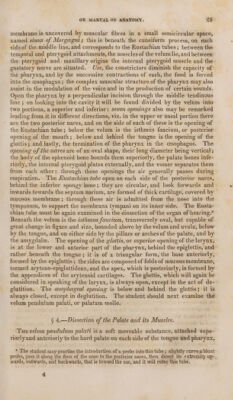
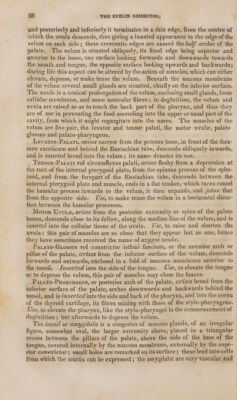
![muscles on the parietes of the thorax. In the inferior and lateral part of the neck, on each side, the phrenic nerve is also seen; this arises by several fine filaments from the third, fourth, fifth cervical nerves; the phrenic nerve descends obliquely inwards along the anterior scalenus muscle, enters the thorax between the subclavian ‘vein and artery, and is distributed to the diaphragm. Previous to examining the deep muscles of the neck, the student should study the anatomy of the mouth, sive ynx, and larynx. § 2.— Dissection of the Mouth, Pharynx and Larynx. Tur cavity of the mouth may be exposed by dividing the commissures of the lips and the cheek of one side, and removing a small portion of the side of the lower jaw; draw forward the tongue with a tenaculum, and cleanse the parts very well. ‘The mouth is bounded anteriorly by the lips, superiorly by the hard and soft palate, laterally by the cheeks, mferiorly by the tongue, and mucous membrane reflected from it to the gums; posteriorly it communi- cates with the pharynx: this opening is named the isthmus fauctums it is bounded above by the velum and uvula, below by the tongue, and on each side by the arches of the palate. The anterior part of the palate, or hard palate, is formed of the palate plates of. the maxillary and palate bones, cov- ered by mucous membrane and glands; the posterior part of the palate, or soft palate, or velum pendulum, consists of a dense aponeurosis, and of several] muscles and glands, enclosed in mucous membrane; the cheeks are formed of mucous membrane, covered hy the buccinator and a quantity of fat; several small mucous glands lie between the membrane and this muscle, and towards the upper and back part on each side we perceive the small opening of Steno’s duct. The mouth is lined throughout by mucous membrane, which is continuous with the cutis on the lips, and extends posteriorly through the pharynx, whence it ascends 'to line the nares, the Eustachian tube and tyni- panum on each side, and descends to line the cesophagus and larynx; as it is reflected from one surface to another, it forms folds or freena, as between the lips and alveoli, and beneath the tongue; at the sides of the fauces, also, it forms two semilunar folds on each side, called the pillars or arches of the palate: these folds enclose muscular fibres, which we shall examine after- wards. On looking into the mouth, either in the living or dead subject, the following objects strike the attention ; inferiorly the tongue and teeth ; later- ally ‘he cheeks; posteriorly the back part of the phary DX 5 diperivily the hard and soft palate, from the centre of the latter, the uvula, and from the sides, the pillars or arches descending to the tongue and pharynx; in the recess between these pillars on each side the tonsil or amygdala is also seen ; lastly, if the tongue be drawn forward, the epiglottis comes into view. | The tongue isof a triangular shape ; its base, thick and broad, 1s connected to the epiglottis and palate by mucous membrane, and to the -os hyoides and mferior hasta by muscles; the apex is thin and unattached; that portion between it and the base is named the body of the tongue; all the upper sur- face, the sides, and. about one third of its inferior surface, are covered by mucous membrane, which is very rough superiorly, from the number of papille that project through it; anteriorly, these papillze are small, conical, and con- nected with the terminations of the nerves of taste; posteriorly they are](https://iiif.wellcomecollection.org/image/b33290738_0032.jp2/full/800%2C/0/default.jpg)