Surgery; its theory and practice / by William Johnson Walsham.
- William Walsham
- Date:
- 1896
Licence: Public Domain Mark
Credit: Surgery; its theory and practice / by William Johnson Walsham. Source: Wellcome Collection.
Provider: This material has been provided by the Augustus C. Long Health Sciences Library at Columbia University and Columbia University Libraries/Information Services, through the Medical Heritage Library. The original may be consulted at the the Augustus C. Long Health Sciences Library at Columbia University and Columbia University.
44/848 (page 42)
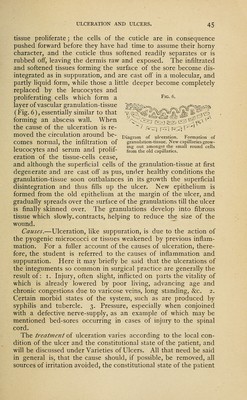
![or by scraping away the unhealthy granulations with a Volk- mann's spoon. Diffuse suppur.'^tion may occur either, i, in the substance of the tissues or organs; or, 2, on the surface of the skin or a mucous or serous membrane. As examples of the former may be cited cellular and cellulo-cutaneous er)'sipelas, in which as the result of a spreading infective inflammation, extensive suppura- tion occurs through large tracts of the subcutaneous tissue; as examples of the latter, gonorrhoea, bronchitis, and some forms of peritonitis. The pathological process in both is practically similar, only that in one the inflammatory products (pus) are diffused through the tissues, and in the other, over the free sur- face. Suppuration on the free surface of the skin or mucous membrane when the deeper layers of these structures are involved, is, however, spoken of generally as ulceration; and when the epithelial layers only are affected, as intertrigo in the case of the skin, and as purulent catarrh in the case of a mucous membrane. Constitutional effects of long-continued suppuration. Hectic fever and lardaceous disease.—Hectic fever is a common ac- companiment of prolonged suppuration from whatever cause when the wound cannot be kept aseptic and efficiently drained. It has been ascribed to the drain on the system owing to the for- mation of large quantities of pus ; but this is certainly not the only cause, as a chronic abscess may attain a very large size, and exist for years unattended by hectic as long as it remains un- opened ; nor after opening does hectic occur if the pus can be prevented from undergoing fermentative or putrefactive changes, and the cavity can be well drained. It would therefore rather appear to be due to a chronic blood-poisoning, consequent upon the absorption of the products of fermentation or putrefaction in small quantities at a time. Symptoms.—Hectic fever ia char- acterized by profuse sweating, rapid wasting, nocturnal rises of temperature with morning remissions, and generally by diarrhoea and deposits of urates in the urine. The face is pale and pinched, the cheek flushed, the eye bright, the pupil dilated, the tongue red and dry at the edges, and the pulse rapid, small and weak. The appetite gradually fails, the patient becomes weaker and weaker, and dies exhausted of diarrhoea, lardaceous disease, etc. Treatment.—The cause of the suppuration should be re- moved, or, if this is impossible, the absorption of septic products should be as far as ])racticable controlled by establishing a free drain to the suppurating cavity, and by preventing by the use of antiseptics the putrefaction of the discharges. At the same time the system must be sujtported by nourishing diet and stimulants, the sweating combated by dilute sulphuric acid or atropine, and the diarrhoea by opium, catechu, or other astringents.](https://iiif.wellcomecollection.org/image/b2120472x_0044.jp2/full/800%2C/0/default.jpg)